Hunting with a Partner: How to Divide Roles, Avoid Friction, and Hunt More Effectively
How to structure a two-person hunting team for elk and mule deer — caller/shooter systems, role division, communication in the field, pack-out advantages, and how to debrief without killing the partnership.

Solo hunting has its appeal — total autonomy, no coordination overhead, a clean emotional ledger at the end of the day. But a well-functioning two-person team will outperform even a skilled solo hunter on most western big-game hunts. More eyes, a functional caller/shooter system, genuine safety backup, and the ability to move a dead elk in two trips instead of six. The math strongly favors the partnership.
The catch is that “hunting with a partner” is only an advantage when the roles are clear, the communication works, and both hunters agree on how decisions get made before anyone is standing 40 yards from a bull elk. A poorly structured two-person team creates friction, blows setups, and makes the debrief conversations uncomfortable. Get the structure right and the hunt runs itself.
Why Two People Beat One
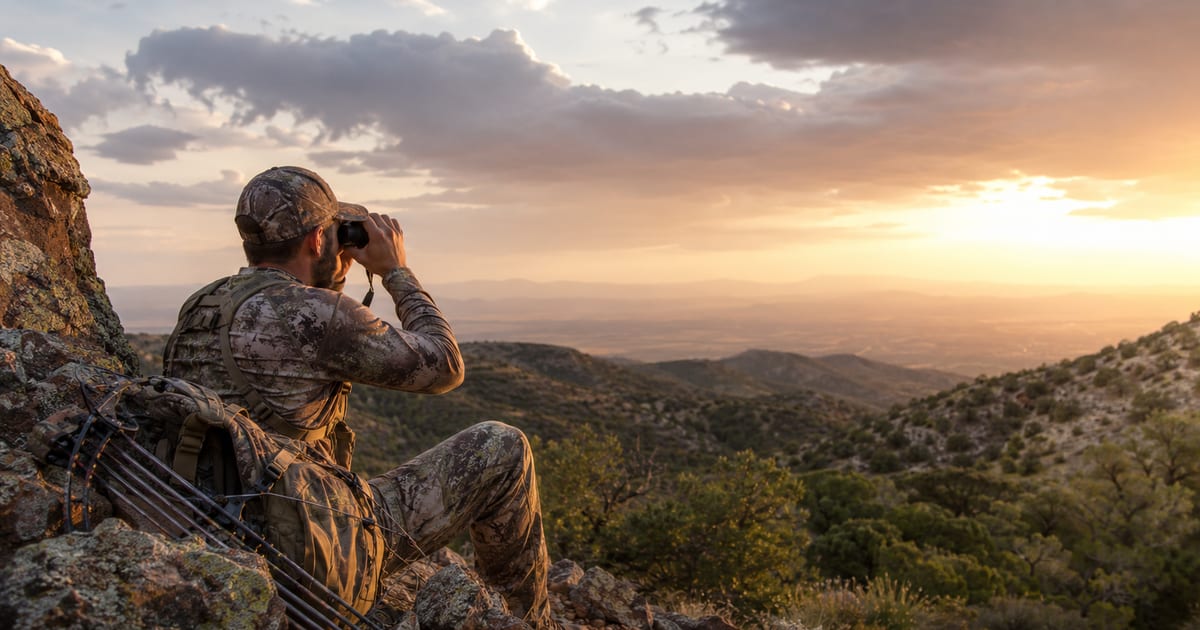
Start with the obvious: glassing. Two sets of eyes covering a basin, two people working a ridge methodically, two hunters picking apart a hillside at first light — you’ll find more animals, find them faster, and identify opportunities the solo hunter misses while he’s adjusting his binos.
For elk in archery season, the two-person team is about as close to a structural advantage as this sport offers. The caller/shooter system — covered in detail below — is simply more effective than solo hunting in most close-range elk encounters. Elk are moving toward a sound source. If the shooter and the sound source are the same person, the bull is walking directly toward the hunter. When they’re separated by 25 yards, the bull walks toward the caller and broadside past the shooter. That geometry is the whole game.
Safety is the other pillar. In serious backcountry — high passes, remote drainages, long packs — having another person present is not just comfort, it’s risk management. A rolled ankle three miles in is manageable with two people. Solo, it becomes a search-and-rescue call at best.
Partnerships Work Best When Both Hunters Are Clear on Roles
The most common source of friction in two-person hunts isn’t effort or personality — it’s ambiguity. Who shoots first if both hunters have elk tags and a bull walks in? Who decides to move or stay? Answer those questions before you leave the trailhead.
Establish Roles Before the Hunt
Have the role conversation explicitly, not implicitly. In the truck, over a map, the night before opening day — but somewhere specific, where both people actually commit.
Who shoots first? If both hunters have tags, decide in advance. It can rotate by day, by species, by who called it — any system works as long as it’s agreed. What doesn’t work is figuring it out in real time when a bull is at 60 yards. The hesitation alone will blow the setup.
Who makes field decisions? On a stalk that’s going sideways, when the wind shifts mid-approach, when a bull hangs up and you need to choose between holding position or repositioning — someone needs to be the deciding voice. The more experienced hunter should usually fill that role. Not because experience equals authority, but because faster, cleaner decisions in the field keep setups alive.
Who handles the calls? This one has a right answer for archery elk, covered below.
Who navigates the pack-out? Decide in advance who carries what, how loads get divided, and whether you’re boning in the field or packing bone-in.
Getting these questions answered before the hunt removes a significant cognitive load once you’re in the field and everything is happening fast.
The Caller/Shooter System for Archery Elk
This is the most technically important concept in two-person elk hunting. Get it right and it’s devastating. Get it wrong and you’ll watch a lot of bulls hang up and walk.
The shooter positions 25 to 30 yards in front of the caller, slightly offset to the side — not directly in line. The caller stays behind and calls toward the likely approach. When the bull responds and commits, he walks toward the source of the calls. That puts him broadside past the shooter’s position before he ever reaches the caller.
The caller creates the illusion. The bull thinks a cow (or a rival bull) is somewhere back in the timber. The shooter is invisible, silent, and already in position between the bull and where he thinks the sound is coming from. It’s an ambush built from sound.
A few rules that don’t have exceptions:
The caller never moves toward the shooter during the approach. If the caller creeps forward to see better, the gap disappears and the geometry collapses.
The shooter doesn’t call. Not a squeak, not a cow mew, nothing. Any sound from the shooter’s position reveals that the “source” is in two places, which reads as wrong to the bull.
When the bull is inside 60 yards, the caller goes quiet. Let the bull’s momentum carry him. Curiosity does the work. A call at 40 yards that comes from the wrong direction compared to what the bull expects is the most common way to blow a close setup.
The Caller Stays Behind the Shooter — Always
The most common mistake in the caller/shooter setup is the caller drifting forward to watch the action. Stay back. Your job is to sound like an elk behind the shooter, not to see the kill. Trust the geometry and hold your position.
Navigating Different Experience Levels
Most hunting partnerships aren’t between two equally experienced hunters. One person usually has more time in the field, more encounters with the target species, more setups that have worked and failed.
The productive structure: the more experienced hunter handles the calls and directs the approach. The less experienced hunter shoots. That’s not charity — it’s tactics. An experienced caller who also wants the first shot creates a conflict of interest every time a good animal comes in. Give the shot to whoever’s learning. The experienced hunter’s job is to put them in position to kill cleanly.
The exception is when the experienced hunter draws a tag through a competitive draw and has genuine reason to want the harvest — that’s a different conversation, and worth having explicitly before the hunt, not during.
Pack-Out Arithmetic
Two people change the pack-out equation dramatically.
A solo hunter moving a mature bull elk at altitude, three miles from the trailhead, will make four to six trips under load. That’s 24 to 36 miles of hiking, much of it with 60-plus pounds on his back. It’s doable. It’s brutal and slow, and with temperatures above 45°F it creates real meat-care pressure on every trip.
Two people move the same bull in two to three trips each. The math is almost halved. You can also split the work so one hunter stays with the meat while the other makes a shuttle — maintaining a continuous watch in bear country, keeping game bags hung and aired, and reducing the window between kill and cooler.
For mule deer, the math is less dramatic but still meaningful. A mature mule deer runs 150 to 200 pounds live weight. Two people can move it in a single trip each with good packing discipline. Solo, it usually means two trips plus a return for anything left behind.
Coordinate the Pack-Out Before the Shot
Know your exit route before you shoot. Two hunters who know the plan — who’s carrying what, where the truck is parked, who stays with the meat — can move an elk efficiently even when things go sideways. Making that plan over a dead elk in fading light wastes the time you actually need to be moving.
Communication in the Field
Radios and hand signals both work. What you choose depends on terrain and hunting style.
Hand signals are the right tool when you’re within visual range and silence matters — during a close approach, when a bull is working toward you, or any time sound could compromise the setup. Agree on a small set of signals before the hunt: stop, move toward me, elk ahead, back out, shoot. Five signals cover 90 percent of field situations.
Radios work for covering more terrain — when one hunter is glassing a far ridge while the other works timber below, or during a long pack-out when you’re splitting up. Keep transmissions short and use an earpiece so the speaker doesn’t broadcast into the field. A brief transmission carries farther than you expect in mountain terrain.
When not to communicate: During any active approach or calling set, both hunters should be in radio silence unless something has gone critically wrong. A whispered conversation at 80 yards, a radio crackle, the sound of a pack shifting — these end hunts. If you’re not sure whether to communicate, don’t.
For two-person mule deer spot-and-stalk, radio communication is usually safer during the stalk itself — one hunter glassing from elevation directs the other with short updates. “Deer still feeding, stay low, move left 20 yards” is the kind of guidance that closes the distance in open country where visibility works both ways.
The Post-Hunt Debrief
A two-person hunt produces twice the perspective and, inevitably, twice as many “what if we’d done that differently” moments. A bull that hung up at 80 yards. A mule deer that saw movement at the wrong second. A caller who got excited and called too aggressively when the bull was almost in range.
Those conversations will happen. Handle them well and they make both hunters better. Handle them poorly and they create resentment that shows up two years later when one person stops returning texts about next season’s hunt.
A few ground rules worth keeping. Wait until camp. Rehashing a blown setup while you’re still standing in the spot where it happened, with adrenaline running, is almost always unproductive. Cover the basics — where the animal went, what you saw — then decompress. The actual learning conversation happens better around a fire.
Separate what you controlled from what you didn’t. A wind shift is not a failure. A caller who moved when they shouldn’t have is a process error worth discussing. Make that distinction before assigning any version of fault.
Keep it short. One clear observation per person, one thing to do differently next time. That’s a productive debrief. An hour of reconstructing every step of a failed approach is how hunting partnerships become strained.
Two people who can shoot, glass, call, pack heavy loads, and debrief without drama are a formidable team. That combination doesn’t happen automatically — it gets built through explicit conversations before the hunt, clear roles in the field, and honest but brief conversations after. Invest in the structure and the hunt runs better than either of you could manage alone.
Next Step
Check Draw Odds for Your State
Tag-level draw odds across 9 western states — filter by species, unit, weapon, and points. Free to use.
Get the Insider Edge
Join hunters getting exclusive draw odds data, gear deals, and weekly hunt planning tips.
Related Articles
Arizona OTC Archery Deer 2026: Unit Limits and Closures
Arizona's OTC archery deer season opens August 21, 2026 — and units close the moment harvest limits fill. Here's every unit's limit, plus the best bets by real archery success rates.
Colorado OTC Elk in 2026: What Changed for Nonresidents
Colorado eliminated unlimited nonresident OTC archery elk west of I-25 for 2026 — and Gunnison rifle tags went draw-only. Here's exactly what's still on the shelf and how to hunt this fall anyway.
Colorado Reissue Licenses: How to Grab Returned Elk Tags
Every Wednesday through fall, CPW sells back surrendered limited licenses — including elk tags nonresidents can't get any other way in 2026. Here's the Tuesday-Wednesday ritual that actually lands one.
No comments yet. Be the first to share your experience!