E-Scouting for Mule Deer: How to Identify High-Probability Units From Your Desk
How to e-scout western mule deer hunting units before the season. Topo maps, satellite imagery, water source analysis, terrain features, and how to narrow a 200,000-acre unit to 50 high-probability acres.
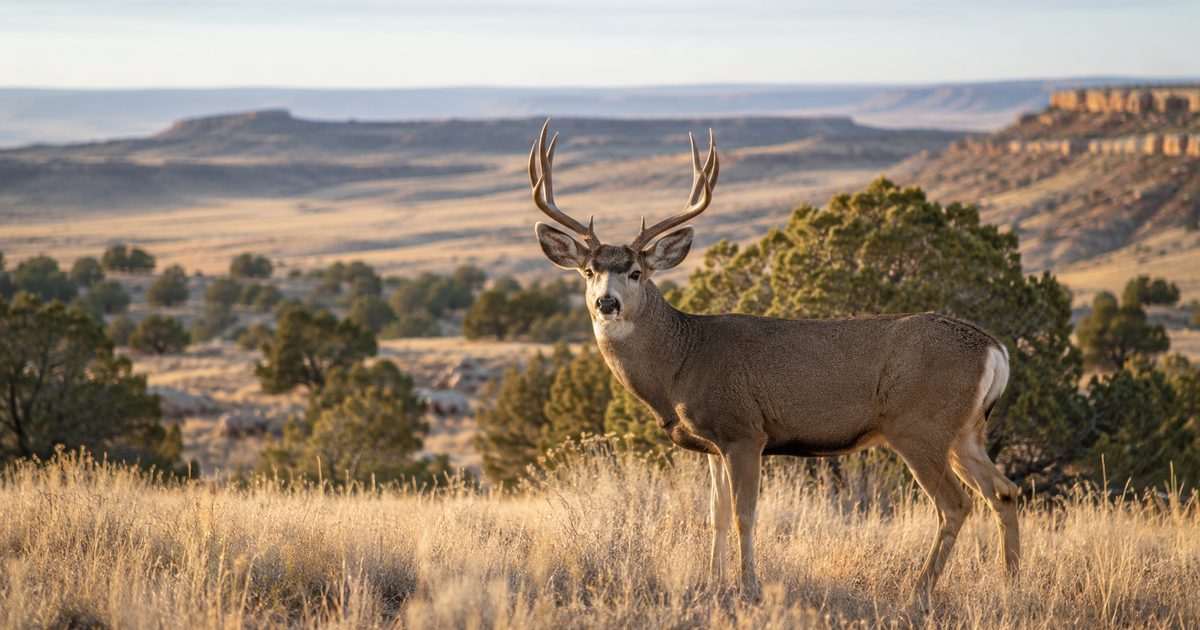
E-scouting matters for mule deer hunting in a way that goes beyond simple convenience. You can hunt elk by covering a drainage until you cut fresh sign and adjust from there — elk leave obvious tracks, heavy beds, and strong-smelling wallows. A mature mule deer buck leaves almost nothing. He bedded on a specific cliff-edge bench, traveled a specific saddle, and drank from a specific spring. If you don’t know where those features are before you arrive, you’ll cover enormous country for little payoff.
The good news: mule deer terrain is highly readable from satellite imagery. Their preferred habitat has a fingerprint — certain aspects, elevation bands, vegetation types, and terrain configurations that mature bucks select for year after year. Once you learn to read that fingerprint in Google Earth or OnX, your e-scouting translates directly to better field hunting. You’re not just “covering country” anymore. You’re moving between identified, high-probability locations.
This guide walks through the complete e-scouting workflow for western mule deer — from identifying unit-level habitat to marking the specific 50 acres where a mature buck is almost certainly spending his summer mornings.
Why Mule Deer E-Scouting Is Different From Elk
Elk use terrain opportunistically. A herd can bed in a creek bottom, a north-facing bench, or a park edge depending on pressure and conditions. Their patterns shift. A mature mule deer buck, by contrast, is one of the most predictable animals in western hunting — but only once you understand what he’s optimizing for.
A big mule deer buck selects terrain that gives him three things simultaneously: visibility of threats approaching from below, escape routes that lead uphill or along cliff edges, and thermal advantage for detecting predators by scent. He doesn’t compromise on these requirements. He won’t bed in a flat drainage bottom no matter how much food is there. He won’t bed on a slope without an escape route that leads somewhere a horse can’t follow.
That specificity is what makes e-scouting so powerful for mule deer. Once you know what the buck is looking for, satellite imagery becomes a filter — you’re eliminating 95% of the unit and focusing on the 5% that matches his requirements.
The Tools You Need
You don’t need a complex software stack. Four tools cover almost everything.
Google Earth Pro (free) is your primary terrain analysis tool. The 3D view lets you virtually fly through drainages, assess slope angles, identify cliff systems and bench terrain, and evaluate escape routes from a buck’s perspective. The historical imagery slider is the feature most hunters don’t know to use — more on that in Step 1.
OnX Hunt ($100/year) provides the land ownership overlay you can’t do without. Public/private boundaries in western mule deer country are often complex checkerboards. OnX also integrates topographic contours with satellite imagery and lets you drop waypoints that sync to your phone for offline field navigation.
USGS National Map / Topo Viewer (free) gives you the highest-quality topographic contours available — better resolution than most mapping apps. Use it to verify terrain steepness and identify the specific bench systems that satellite imagery hints at.
ProHunt’s Hunt Unit Finder and Land Access Mapper layer harvest data, public land boundaries, and water source information directly onto your unit map. Harvest cluster data in particular tells you where hunters have historically found and killed bucks — which reveals both pressure patterns and where animals actually live.
Step 1 — Identify Water Sources
In most western mule deer country — Nevada, Utah, Arizona, Wyoming — water is the single factor that concentrates deer during August and September archery and early rifle seasons. Temperatures run 85-100°F. Every year-round spring, livestock tank, and reliable seep in the unit will have mule deer traffic at dawn and dusk.
Open your unit in Google Earth. Start by finding all visible water: the blue lines of perennial creeks, the small circular reflections of stock tanks, the unusually green vegetation patches in otherwise dry slopes that indicate a spring or seep. Mark each one as a waypoint. In dry years, tighten your focus to the most reliable sources — a seasonal pond that holds water in a wet year may be bone-dry in a drought year, and the deer will have shifted to the three or four sources that never fail.
Use Historical Imagery to Find Drought-Year Water
Google Earth Pro’s historical imagery slider — the clock icon in the toolbar — lets you view satellite photos from multiple years. Compare a wet year to a drought year in your unit. The water sources that still show green vegetation in a drought year are the ones that never go dry. Deer learn which sources are reliable. In any year, the permanent water gets more deer traffic than the seasonal stuff, but in a drought year, permanent water is the only water. Build your plan around it.
Once you’ve mapped water, rank sources by remoteness. A stock tank one mile from a two-track road will get hunter pressure all season. A spring six miles up a drainage that requires a 2,000-foot climb to reach will have deer that have almost never been disturbed by a human on foot.
Step 2 — Find the Terrain Features
Mule deer bucks are edge animals in the most literal sense. They live on the edges of things — the edge of a cliff, the edge of a bench, the transition from one vegetation type to another. Learning to identify these features in satellite imagery is the core skill of mule deer e-scouting.
Cliff-edge bench systems. This is the single highest-priority feature to find. Look for places where a steep cliff or talus band transitions to a more gentle bench — typically 5-25 acres of moderate terrain sitting above a cliff that makes approach from below extremely difficult. Mature bucks bed on these benches because they can see any threat approaching from the drainage below and escape along the cliff top if pressure comes from uphill. In Google Earth’s 3D view, rotate the terrain to look at these transitions in profile. A bench that looks flat from above often has 50-foot cliff faces below it that you’d only discover by rotating your perspective.
South-facing escape terrain. South-facing slopes in mule deer country carry sparse vegetation — scattered juniper, cliff rose, sage — because the aspect is drier and warmer. Bucks use these slopes specifically because the open vegetation gives them exceptional visibility. They’ll often be visible on these slopes at dawn and dusk, feeding or traveling. Mark every significant south-facing open slope in the unit.
Saddles connecting drainages. Low points on ridgelines where a buck can step from one drainage into another. Bucks use these consistently for travel because they minimize elevation change while letting them survey both drainages simultaneously. These are some of the best ambush points in western hunting — mark every saddle in your primary hunting area.
North-facing timber adjacent to open parks. Bucks bed in the timber and feed in the open areas at their edges. North-facing slopes hold denser, cooler timber that deer prefer for midday beds in warm weather. Look for places where dark timber on a north face meets a meadow or park — these edge zones are morning and evening hot spots.
Step 3 — Map the Escape Routes
A mature mule deer buck has already survived at least two or three hunting seasons. He knows what hunters look like and where they come from. He beds where he can see pressure arriving from below and escape somewhere humans can’t easily follow.
Zoom into your candidate bedding areas on Google Earth and ask: where would a buck go if a hunter walked in from below? The answer almost always leads to a cliff band that continues along the ridge, a boulder field that a horse or ATV can’t navigate, or a series of benches that require technical climbing to follow. Those locations — the places where pursuit becomes genuinely difficult — are where mature bucks feel safest.
Mark the escape routes, not just the bedding zones. A buck who has lived in a drainage for two years knows every route out of his bedding area. He’ll use the same one every time pressure comes from the same direction. If you can identify the likely escape and get to it first, you’re ahead of nearly every other hunter in the unit.
Step 4 — Overlay Historical Harvest Data
Harvest data requires careful interpretation for mule deer scouting. Clusters of historical kills on ProHunt’s Game Activity Predictor don’t necessarily mean that’s where the best bucks live — they mean that’s where hunters have historically been able to find and kill deer. Those are related but different questions.
The drainages with dense harvest clusters near road access are almost certainly hunted hard every year. Deer that survive in those areas learn to go nocturnal or move to adjacent drainages with less pressure. Look at the harvest data and then find the adjacent drainages that have similar terrain but dramatically fewer reported kills. This is where the older, larger bucks often end up — not because the terrain is better, but because the hunting pressure is lower and the survivors have learned to use it.
Conversely, if you find a remote drainage with two or three reported kills from the past several years, that’s actually useful signal. It means deer are there and at least occasionally killable — you just need to commit to the access challenge that most hunters won’t bother with.
Verify Land Ownership Before Committing to a Spot
Private land in western mule deer country can be invisible at normal map zoom levels. A drainage that looks entirely public can have 40-acre private parcels sitting at the bottom of the approach — meaning you’d be trespassing before you even start the climb. Always verify land ownership in OnX or ProHunt’s Land Access Mapper at maximum zoom level before an e-scouted location becomes an actual access plan. Mark the private boundaries on your map and identify legal routes around them.
Step 5 — Plan Your Glassing Positions
Mule deer hunting in the West is a glassing game. You don’t wander through habitat hoping to bump into a buck — you find elevated positions with broad sightlines, sit behind your optics at dawn and dusk, and locate deer before you move. Your e-scouting work is the foundation of that glassing strategy.
After you’ve identified water sources, bedding terrain, south-facing slopes, and saddles, step back and identify the high points that give you sightlines into multiple of these features simultaneously. You want a glassing position from which you can watch a water source, two or three likely bedding benches, and a south-facing slope all in the same session. If a buck shows up on any of them, you can watch long enough to evaluate him before committing to a stalk.
Mark three to five glassing positions in your primary hunting area. Note the time of day each position is best — a ridge that faces east gives you excellent morning light on your subject but harsh glare in the afternoon. Plan your daily schedule around these positions: morning glass from Position A (faces east, overlooking water and south-facing slopes), midday glass from Position B (higher elevation, overlooking multiple saddles and bedding benches), evening glass from Position A or C.
Distance from camp matters here too. A glassing position that requires a two-hour hike in the dark to reach before first light will get skipped on days when you’re tired. Try to identify positions accessible in 45-90 minutes of hiking to make sure you’ll actually use them consistently.
Build the Right Glassing Kit Before You Go
Quality dawn glassing for mule deer requires at minimum a 10x42 binocular on a tripod or window mount and a 65mm+ spotting scope on a fluid-head tripod. The binocular finds the deer; the spotting scope evaluates the buck. A binocular tripod adapter — the simple kind that threads into a photo tripod head — transforms a handheld 10x42 into a stable, fatigue-free glassing tool. At 400-600 yards in low light, the difference between shaky handheld glass and a stable image is the difference between “I can’t tell if he’s a shooter” and “I can count his tines.”
After E-Scouting: Boot Verification
E-scouting narrows your search area from 200,000 acres to a handful of specific locations. It doesn’t verify those locations. Physical pre-season scouting in July or early August confirms what satellite imagery suggested.
When you boot-scout your e-scouted locations, you’re looking for three things: active deer sign (fresh tracks, beds, trails to water), camera placement opportunities at water sources and saddles, and shed antlers from the previous year. A shed antler from a previous fall in a specific canyon is one of the best pieces of evidence you can find — it tells you a buck of a specific caliber survived last hunting season and was using that terrain. He’s probably still there.
Camera placement at the water sources you identified in Step 1 is worth the effort for any hunt you’ve drawn with significant preference points. Place cameras 6-8 weeks before the season and check them remotely if you have a cellular-enabled camera or physically pull cards once in late summer. Even a single photo of a target-class buck at a specific water source changes everything about how you plan your opening week.
Use ProHunt’s Draw Odds Engine to prioritize which units deserve the most intensive e-scouting and pre-season boot time. A once-in-a-decade draw tag merits 40-50 hours of e-scouting and two boot-scouting trips. An OTC tag in a unit you’ve hunted before might need only a few hours of targeted verification.
Putting It Together: The 50-Acre Target
Done well, mule deer e-scouting should funnel you from an entire unit down to a small number of very specific locations. Start with the water map. Eliminate water sources that are too accessible or too unreliable. Find the cliff-edge bench terrain near the best remote water. Identify the escape routes off those benches. Mark the glassing positions that cover the most ground simultaneously. Export everything to OnX as categorized waypoints.
By the time you drive to the trailhead on opening morning, you should know which three drainages you’ll glass, which specific benches you’re watching for a bedded buck, where you think he’ll water, and which saddle you’ll use to approach if you spot him on the far side of the ridge. That’s the difference between hunting a 200,000-acre unit and hunting 50 high-probability acres — and it all happens before you leave home.
Next Step
Check Draw Odds for Your State
Tag-level draw odds across 9 western states — filter by species, unit, weapon, and points. Free to use.
Get the Insider Edge
Join hunters getting exclusive draw odds data, gear deals, and weekly hunt planning tips.
Related Articles

Arizona Elk Calling: September Archery
September archery elk in Arizona means calling. Here's the practical guide to bugles, cow calls, and the timing that produces bulls.
Arizona Hound Hunting Regulations Guide
Arizona hound hunting for bear and lion requires specific permits and tags. Here's the complete regulatory guide for 2026.

Arizona Shed Hunting: Rules & Season Guide
Arizona has specific rules on shed antler collecting. Here's the complete guide to the season, the ethics, and the most productive areas.
No comments yet. Be the first to share your experience!