Wind and Thermals for Deer Hunters: How to Stay Undetected in Western Terrain
How wind and thermal behavior affects western deer hunting. Reading thermals in mountain terrain, when to approach vs. wait, how to stay out of your deer's nose, and the wind management decisions that separate consistent deer hunters from inconsistent ones.
A mule deer that hears an unusual sound may stop, look, and investigate. A mule deer that smells you will leave immediately. It won’t come back that day. It may not come back to that drainage for a week.
That asymmetry defines western deer hunting. Sound management matters. Movement matters. But scent management is the first variable in every decision you make — where to approach from, when to move, which route to take, whether to commit to a stalk or wait. Hunters who internalize this spend their time solving wind problems. Hunters who treat it as secondary spend their time wondering why their deer blew out of a drainage they were certain held animals.
Wind management in western mountain terrain is more complicated than “hunt into the wind.” Thermals, canyon deflections, prevailing wind direction, and the transitional dead zone between thermal cycles all affect where your scent goes — and when. Here’s how to read all of it.
What Thermals Are and Why They Matter
Thermals are wind currents driven by temperature differentials in mountain terrain. They operate independently of the prevailing wind direction — and in light-breeze conditions, they often dominate. Understanding them is the baseline skill for western deer hunting.
Morning thermals (downslope): As the sun rises, air at lower elevations warms faster than air higher up. Cold, dense air at elevation flows downhill into drainages and canyon bottoms. This downslope movement typically begins about 30 minutes before sunrise and persists until 2 hours after sunrise, though cloud cover, elevation, and canyon depth all affect timing. In a deep canyon on an overcast morning, downslope thermals may run later. On a sunny south-facing slope, they may switch earlier.
Afternoon thermals (upslope): As the terrain heats up, air near the warm ground rises. Thermals reverse — air flows up out of drainages and up the slope faces. This transition typically completes by 10-11am in most western terrain and holds until late afternoon or sunset.
Both of these patterns are predictable enough to plan around. They’re the reason the “approach from above in the morning” principle works. That’s not just a terrain advantage — it’s thermal management. The downslope morning thermal carries your scent away from deer below you. Remove that thermal logic and the approach from above stops making sense.
The Transitional Dead Zone
Between downslope and upslope, there’s a window of roughly 20-40 minutes when the thermal is switching directions. During this window, air movement becomes unpredictable and swirling. Your scent may rise, fall, eddy against a cliff face, or move laterally depending on small terrain features you can’t see.
The Transitional Dead Zone
The 20-40 minute window between downslope and upslope thermals is the least predictable scent window of the day. Air movement eddies and swirls based on small terrain features, making scent direction genuinely unreliable. Many deer encounters happen during this window — because neither hunter nor deer has a reliable read on where scent is moving.
This is worth understanding for a specific reason: deer encounters during the dead zone are common. Why? Because both the hunter and the deer are operating with less reliable scent information than they’d have at any other time of day. Deer that were holding tight on downslope thermals may start moving. Hunters who have been stationary may choose to move. And neither party is sure exactly where the other’s scent is going.
If a deer blows during the transitional window and you know your approach was reasonable, it may not have been your fault. Dead zone encounters are genuinely difficult to control. The practical response is to be stationary during the transition — let the thermal establish before committing to a stalk or a movement.
Canyon Terrain Complicates Everything
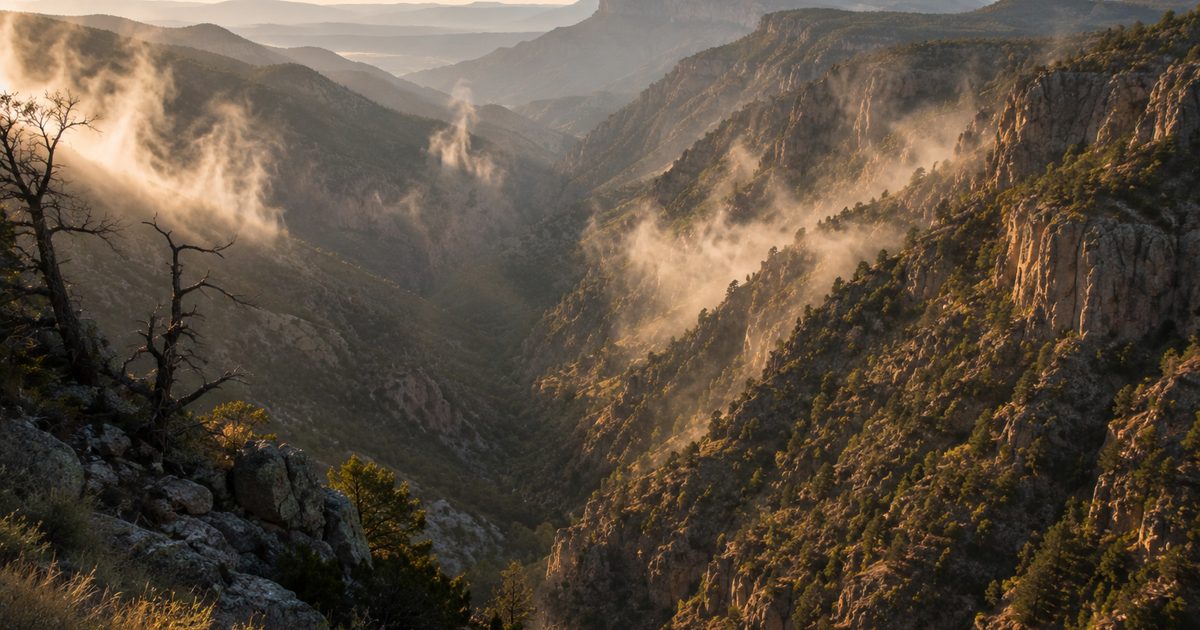
The basic upslope/downslope model describes flat-slope terrain. In canyon country with multiple drainages, cliff faces, and opposing slopes, air movement gets significantly more complex.
Air flowing down one drainage may hit a cliff face, eddy, and reverse direction or deflect at 90 degrees. A canyon with two tributaries joining at a junction may have different thermals in each tributary at the same time. The slope you’re on and the slope opposite you may have thermals moving in different directions simultaneously.
Canyon Thermal Complexity
In multi-drainage canyon terrain, the basic upslope/downslope model breaks down. Cliff faces deflect air, tributary junctions create eddies, and opposing slopes may have thermals moving in different directions at the same time. Don’t rely on the general model in complex canyon terrain — test the air physically before committing.
The only reliable approach in complex canyon terrain is to test the actual air movement at your position, not assume it from the model. A smoke puffer, milkweed seeds, or a small squeeze bottle of talcum powder gives you a visible read on what the air is doing right now at your exact location. Test continuously while approaching — the thermal can shift within 50 yards as terrain features change.
Don’t trust a wet finger for anything critical. The smoke test isn’t excessive — it’s what separates systematic scent management from hoping the wind cooperates.
Planning a Stalk Around Thermal Timing
Given the thermal patterns and their limitations, here’s how to structure approach decisions.
Morning stalks: Approach from above and downslope of the deer’s position. The downslope thermal carries your scent away from deer below you. Work into the drainage from the top, staying above the animals. This is the highest-percentage morning approach in terrain that allows it.
Afternoon stalks: The upslope thermal is now carrying scent toward deer positioned on slopes above you. If you’re below the deer in the afternoon, you’re effectively pointing your scent cone directly at them. Wait for an approach angle that puts you downwind at their elevation or above, where the rising thermal moves your scent away.
Morning Approach from Above
“Approach from above in the morning” is thermal management, not just terrain strategy. The downslope morning thermal is carrying your scent away from deer below you — that’s why the approach works. Understand the thermal logic and you can apply it to any terrain configuration, not just the textbook above-and-below setup.
The catch is that terrain rarely gives you a clean option. Most stalks involve a compromise position where the thermal isn’t perfect. Knowing the thermal direction helps you pick the least bad option rather than the best one — which is most of what hunting comes down to in technical terrain.
Wind vs. Thermals: Which One Governs
In strong prevailing wind — 10 mph and up — the thermal effect gets overwhelmed. Wind-driven air movement replaces thermal movement, and the hilltop wind reading matters more than the drainage thermal. In those conditions, use a wind checker at your position and factor in how the terrain is channeling the prevailing wind.
In light breezes under 5 mph, thermals dominate. The prevailing wind direction barely matters; the thermal cycle is what’s moving your scent.
At moderate wind (5-10 mph), both forces interact. Thermals and wind may work in the same direction or against each other. This is the most difficult condition to read accurately, and it’s also the most common condition in western mountain terrain during morning and evening deer movement windows.
The practical upshot: always check both. Note the prevailing wind direction from a high point before you drop into a drainage. Then test the thermal at your level as you approach. If they’re moving in compatible directions, you have good information. If they’re conflicting, slow down and test more frequently.
Still-Hunting and Wind Management
Hunters moving slowly through timber or brush face a different wind problem than hunters on a stationary setup. Movement generates noise, and it also changes your position relative to the wind in real time.
Move into the prevailing wind as a baseline. When terrain forces a cross-wind or downwind segment, slow down significantly and use terrain cover — ridgeline dips, brush edges, and creek banks to break your silhouette and limit scent exposure. Never still-hunt directly downwind into a drainage you know or believe holds deer. If you have to cross a downwind gap, shorten the crossing, move faster through it, and accept that you may have pushed deer ahead of you in that zone.
The wind management decisions in still-hunting are continuous, not one-time. Every 50 yards, check the thermal with your smoke bottle. If the direction has shifted unfavorably, adjust your route or stop and wait for conditions to stabilize. Still-hunting slowly enough to catch deer in the open requires getting those continuous decisions right — one bad segment can burn the entire drainage.
The Practical Wind Test
Test the Wind, Don't Guess It
A smoke bottle or milkweed seeds are the definitive wind test. A wet finger can read gross wind direction but misses thermals, eddies, and subtle directional shifts. Test before committing to any stalk approach — the visual confirmation of where your scent is actually going is worth more than any model prediction.
Milkweed seed pods carried in a jacket pocket are the classic field test. Squeeze one and watch where the seeds drift — they’re light enough to follow thermals rather than falling straight down. A small plastic squeeze bottle with talcum powder gives you a more controllable visible puff. Either works. Use one continuously during any approach where the scent situation is unclear.
The hunters who blow stalks on deer they shouldn’t blow consistently share one pattern: they trusted the model instead of testing. Western terrain is too variable, and the stakes are too high, to skip the physical confirmation. If your scent is going where you think it’s going, the test confirms it and costs you 30 seconds. If it’s not, the test saves the stalk.
Wind management isn’t the flashy part of western deer hunting. It’s the part that determines whether everything else — the glassing, the terrain selection, the approach — actually works.
Next Step
Check Draw Odds for Your State
Tag-level draw odds across 9 western states — filter by species, unit, weapon, and points. Free to use.
Get the Insider Edge
Join hunters getting exclusive draw odds data, gear deals, and weekly hunt planning tips.
Related Articles

Arizona Elk Calling: September Archery
September archery elk in Arizona means calling. Here's the practical guide to bugles, cow calls, and the timing that produces bulls.
Arizona Hound Hunting Regulations Guide
Arizona hound hunting for bear and lion requires specific permits and tags. Here's the complete regulatory guide for 2026.

Arizona Shed Hunting: Rules & Season Guide
Arizona has specific rules on shed antler collecting. Here's the complete guide to the season, the ethics, and the most productive areas.
No comments yet. Be the first to share your experience!