Pick Your First Hunting Weapon: Rifle, Bow, or Shotgun
Each hunting weapon has different seasons, ranges, and learning curves. This chapter helps first-time hunters choose the right weapon based on their situation.
This article contains affiliate links. We may earn a small commission if you purchase through these links, at no extra cost to you.
The weapon you choose for your first season isn’t just a preference decision — it determines when you hunt, how far you can shoot, how much gear you need, how long it takes to become proficient, and what your total first-year cost looks like. Get it wrong and you’re stuck practicing archery for six months when you just wanted to go deer hunting in November.
This chapter gives you the framework to make the right call for your situation. Not the coolest option. Not the most impressive answer at the range. The one that actually makes sense for a first-time hunter based on where you hunt, what seasons are available, and how much time you’re willing to invest in practice.
The Four Main Hunting Weapon Types
Before getting into detail, here’s where each weapon category fits:
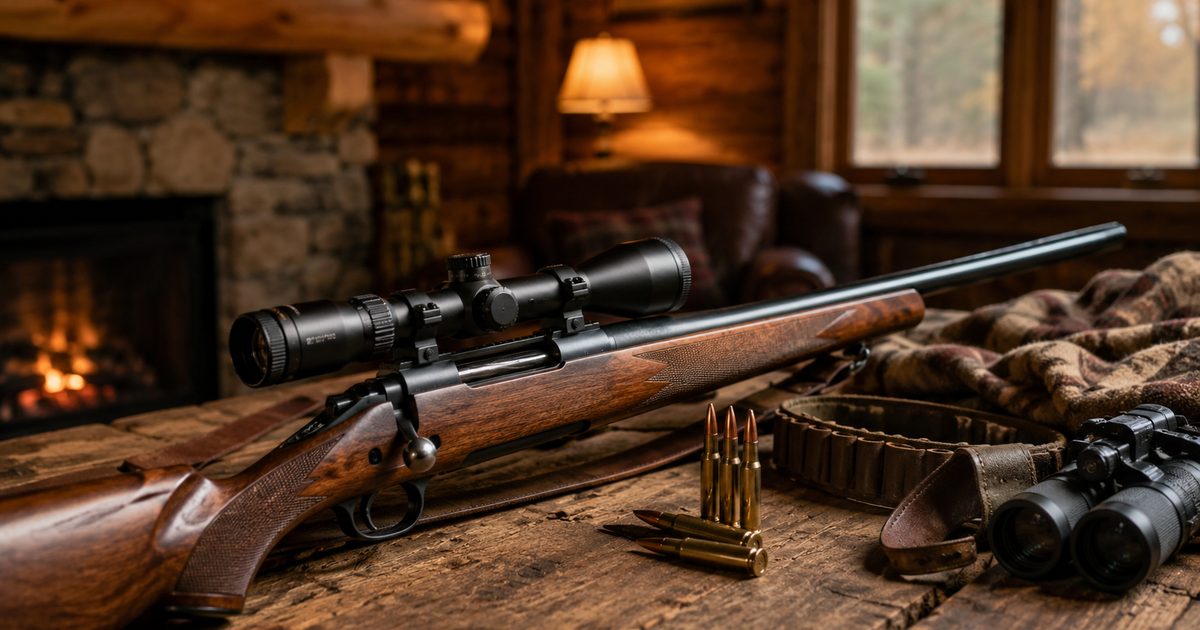
Centerfire rifle — most versatile option for hunters. Effective from 100 to 400+ yards. Available for general firearms seasons in virtually every state. The fastest path to proficiency. Works for deer, elk, antelope, hogs, and most North American big game.
Shotgun — required in certain states and zones (primarily flat Midwestern and eastern states with safety restrictions), and the standard choice for turkey and upland bird hunting. With the right setup, a single shotgun handles deer season, turkey season, and bird hunting.
Archery (compound bow or crossbow) — offers separate, earlier, and often longer seasons with less hunting pressure. Has a meaningful learning curve and a shorter effective range of 30–50 yards for most beginners. Crossbows are an easier entry point and are legal during archery season in most states.
Muzzleloader — a single-shot, black powder firearm that occupies its own dedicated season in most states, positioned between archery and rifle seasons. Modern inline muzzleloaders are accurate and user-friendly. Single-shot design and weather sensitivity are the main trade-offs.
Each of these weapons has genuine advocates who hunt successfully with them year after year. The question isn’t which one is “best” — it’s which one fits your situation right now.
The Rifle — The Right Choice for Most Beginners
If you’re a first-time hunter without strong reasons to choose something else, start with a centerfire rifle. Here’s why.
Range and margin for error. A scoped rifle allows confident, ethical shots at 100 to 300 yards in most hunting scenarios. That range of error is forgiving for beginners still learning to read distances, control nerves, and find a clean shooting lane. Compare that to archery, where a 40-yard shot requires everything to go perfectly.
Universal season availability. Firearms seasons run in all 50 states for deer. If you’re hunting big game, there’s almost certainly a general rifle season available to you. You don’t have to navigate special permits or restricted zones before you’ve even tagged your first animal.
Fast path to proficiency. A modern scoped bolt-action rifle with good factory ammunition is mechanically accurate. Most beginners can achieve consistent groups at 100 yards after an afternoon at the range. The skill ceiling is higher — reading wind, estimating range, shooting from field positions — but the floor is accessible within a single practice session.
What caliber should you buy? For deer-sized game, don’t overthink this. The following calibers all reliably kill whitetail and mule deer at hunting ranges: .243 Winchester, 6.5 Creedmoor, .308 Winchester, .30-06 Springfield, and 7mm-08 Remington. Any of these will do the job.
For beginners specifically, 6.5 Creedmoor and .308 Winchester are the two most popular choices right now, and for good reason. Both have manageable recoil, wide ammunition selection at reasonable prices, and excellent factory rifle availability. Either one is a sound choice.
Cost. A complete rifle and scope setup from a reliable mid-tier manufacturer runs $400 to $800. The Savage Axis II, Ruger American, and Tikka T3x all fall in this range and are genuinely capable rifles — not budget compromises. You don’t need to spend $1,200 to get a rifle that shoots sub-MOA groups. The cheapest end of the market ($200–250) tends to have inconsistency issues worth avoiding. Spend $350–600 on the rifle itself and you’ll have something that works.
Sighting In Your First Rifle
Buy your first rifle package from a sporting goods store that includes bore-sighting. Ask them to sight it in for 100 yards. Then practice from a bench until you can consistently hit a 6-inch circle, then move to field positions. This process takes one afternoon.
The Shotgun — When to Choose It
The shotgun isn’t the default beginner choice for deer, but it’s the right answer in specific situations.
Shotgun-only zones. Many Midwestern and eastern states divide their territory into hunting zones. In flat terrain — think much of Indiana, Illinois, Iowa, Ohio, and parts of Pennsylvania — centerfire rifle bullets carry too far for densely populated areas. These zones require shotgun slugs for deer hunting. Before you buy anything, look up your state’s zone map. If you’re in a restricted zone, the decision is made for you.
Turkey and upland bird hunting. If turkey or bird hunting is part of your plan, a 12-gauge shotgun is the standard tool. For turkey: a 12-gauge with 3-inch or 3.5-inch turkey loads and a tight turkey choke. For pheasant, quail, or ruffed grouse: 12 or 20 gauge with appropriate shot size. One shotgun covers all of it.
The case for multi-purpose shotgun use. If you’re in a shotgun zone AND want to hunt turkey, one shotgun handles your entire season with two types of ammunition and maybe a barrel or choke swap. That’s a practical argument for the shotgun as a first weapon if your situation calls for it.
Cost. A quality pump shotgun runs $250 to $500. The Mossberg 500, Remington 870, and Winchester SXP are the three most common recommendations in this category, and all three have decades of reliable use behind them. Add $100 to $200 for a rifled slug barrel and improved sights if deer hunting is the primary use.
Archery Hunting — Choose This if You Want More Hunting Time
Archery is the right choice if you specifically want extended hunting seasons and are willing to invest the practice time required to hunt ethically at shorter ranges.
Most states offer a dedicated archery season that opens weeks or months before general firearms season. This means more time in the woods, more opportunity to pattern animals before pressure changes their behavior, and significantly fewer hunters in the field. Those are real advantages that experienced hunters value.
But the trade-off is real. Compound bows require consistent practice — 20 or more arrows per week to maintain proficiency, more to improve it. Effective range for most beginners tops out at 30 to 50 yards, which means shots at that range require precise mechanics, good concealment, and patience for the right angle. A marginal shot placement at 40 yards is a wounded animal, not a clean kill.
Don’t choose archery because you think firearms are unsportsmanlike. Both are ethical, legal, and effective methods that hunters have used for generations. Choose archery if you genuinely want the challenge and have the time to practice.
Crossbows are worth considering if you’re drawn to archery but want a lower learning curve. Crossbows are legal in archery seasons in most states (verify yours before purchasing), and they shoot more like a firearm — aim, hold steady, and squeeze the trigger rather than managing draw, anchor, and release simultaneously. The accuracy gap between a crossbow and a compound bow for beginners is significant.
Cost. A complete entry-level compound bow setup — bow, arrows, release aid, and sight — runs $400 to $800. A functional crossbow setup runs $400 to $900. Don’t buy the cheapest bow on the shelf. Accuracy problems at the entry end of the bow market are common, and a bow that won’t group arrows at 30 yards isn’t useful for hunting.
Get a Proper Bow Fitting
Don’t purchase archery equipment without expert fitting. A bow that isn’t sized for your draw length is inaccurate and potentially dangerous. Go to an archery shop for a proper fitting — major chains like Bass Pro have archery technicians who can set you up correctly.
The Muzzleloader — Choose This for an Extra Season
Muzzleloaders occupy a specific niche: hunters who want an additional season without fully committing to archery. Most states with dedicated muzzleloader seasons place them between archery and general rifle season — a window that often produces excellent hunting as animals begin responding to pre-rut behavior.
Modern inline muzzleloaders — the CVA Optima, Traditions Pursuit, and similar designs — are not the complicated black powder rifles from history class. They use pelletized powder, 209 primers, and saboted bullets. They’re accurate to 150 yards and relatively straightforward to operate once you understand the loading sequence. They’re not as complex as traditional flintlocks, but they require more steps than a bolt-action rifle.
The downsides are real: single shot means one opportunity before a long reload. Moisture sensitivity is a legitimate concern in wet conditions. Cleaning is more involved than cleaning a centerfire rifle.
If your state has a muzzleloader season and you’ve already got a rifle for general season, adding a muzzleloader in year two or three gives you meaningfully more hunting time for a modest investment. As a first weapon for someone with no firearms experience, a rifle is still the better starting point.
Cost. A quality inline muzzleloader runs $200 to $500. Add $50 to $100 for powder, primers, projectiles, and a cleaning kit.
Decision Framework
Work through these questions in order and you’ll land in the right place:
Does your state or zone require a shotgun for deer? If yes, start there. Look up your state’s hunting regulation zone map — this information is on every state fish and game website.
Are you in open western terrain? Rifle. Long-range shots across open country are common in the West. Archery and muzzleloader require you to close distance significantly, and that’s a different hunt entirely from what most western public land deer and elk hunting looks like.
Do you want the maximum number of hunting days? Rifle for general season, then add muzzleloader or archery as a second method in future seasons. Starting with multiple weapons at once spreads your practice time too thin.
Are you committed to practicing throughout the off-season? If you have the time and want the challenge, consider archery. If you’re not certain you’ll be able to dedicate regular range time, start with a rifle and revisit archery later.
Working with a tight budget? The rifle gives you the best versatility per dollar. One rifle handles most North American big game hunting in most states.
What It Costs to Get Started
Here are realistic total investment ranges for a first-time deer hunter, weapon to opening day:
Centerfire rifle: $400–800 (rifle with or without included scope) + $100–250 (scope if not included) + $50–100 (ammunition for practice and the season) = $550–1,150 total
Shotgun: $250–500 (pump shotgun) + $100–200 (slug barrel and sights setup) + $50–80 (ammunition) = $400–780 total
Compound bow: $400–800 (bow with basic accessories) + $150–300 (quality arrows, release aid, broadheads, target) + $50–100 (practice) = $600–1,200 total
Crossbow: $400–900 (crossbow with scope) + $100–200 (bolts, broadheads, target) = $500–1,100 total
Muzzleloader: $200–500 (inline muzzleloader) + $50–100 (powder, primers, projectiles, cleaning kit) = $250–600 total
Rifles offer the best value in terms of versatility per dollar. A $600 rifle setup handles deer season across most of North America. A $600 bow setup handles archery season — and only archery season — within 50 yards.
Note that these numbers are weapon costs only. Factor in your hunting license, tags, hunter education if required in your state, and clothing and gear separately. The gear guide in chapter 3 of this series covers those costs.
Practice Before Season — This Part Is Non-Negotiable
Whatever weapon you choose, inadequate practice before the season opens is the most common beginner mistake. Animals don’t hold still. Shots happen at awkward angles. Nerves are real. The only thing that makes any of that manageable is practice.
For rifle hunters: Sight in at 100 yards. Know exactly where your bullet hits at 50, 100, and 150 yards so you don’t have to do math while an animal is standing in front of you. Practice from field positions — sitting against a tree, kneeling, prone — not just from a bench. Bench shooting builds confidence but doesn’t prepare you for a real hunting shot. Know your maximum comfortable range and stay inside it.
For shotgun slug hunters: Pattern your specific ammunition at 50, 75, and 100 yards. Slug performance varies significantly between loads. Know what your setup actually does before the season opens.
For bow hunters: Shoot at hunting distances regularly. Practice in your hunting clothes, from a seated position, with gloves on if you’ll be wearing them in the field. The draw cycle feels completely different in a heavy jacket versus a t-shirt, and that difference will show up in your groups.
For muzzleloader hunters: Practice the loading sequence until it’s automatic. Run through it at home, dry, until you can do it in the dark. On a follow-up shot opportunity, fumbling through the loading process costs you the animal.
Start practicing two to three months before your season opens. One range session the week before opening day is not preparation — it’s a confidence check that may go poorly.
Licensing by Weapon Type — Read This Before You Buy
Many hunters overlook this and show up to their first season with the wrong license.
In most states, your hunting license specifies what methods are legal for you. An archery license typically allows hunting only during archery season with archery equipment. A firearms license covers general firearms seasons. Some states sell combination licenses that cover all methods. Other states require separate licenses for each weapon type, each with its own associated fee.
Before you finalize your weapon choice, look up your state’s licensing structure. You need to know: what license covers the season and weapon you’re hunting with, whether that license comes with a deer tag or whether tags are purchased separately, and whether a separate archery or muzzleloader stamp or permit is required for those seasons.
This information is free on your state fish and game website. Hunting regulations are posted there every year before season opens. Read the section that applies to your weapon and zone before opening day.
Choosing One and Hunting
There’s no wrong weapon here. Hunters tag deer every year with all four methods, in all kinds of conditions and terrain. The guy who kills a mature whitetail with a flintlock muzzleloader at 60 yards didn’t do it because the muzzleloader is superior — he did it because he learned his weapon, practiced enough to be competent, and put himself in the right position at the right time.
For most first-time hunters, a centerfire rifle is the most accessible starting point. It offers the fastest path to competence, works across the most seasons and states, and delivers the most value per dollar spent. But if your zone requires a shotgun, get the shotgun. If you’re passionate about archery, buy the bow and commit to the practice it requires.
Pick one weapon. Learn it well this season. Add other methods once you understand how hunting actually works in the field. The seasons, the situations, and the reasons to diversify your methods will become obvious after you’ve tagged a few animals and built a real foundation.
Chapter 5 of this series covers sighting in and practicing with your weapon before the season opens — including exactly what range work looks like for each weapon type.
Continue the Beginner’s Guide
Previous: ← Chapter 3 — Best Species for Beginners
Next up: Chapter 5 — Ammo & Arrows →
Free Tools
Plan Your Next Hunt
Draw odds, unit guides, deadline tracking, and 38+ planning tools — free for every western hunter.
Get the Insider Edge
Join hunters getting exclusive draw odds data, gear deals, and weekly hunt planning tips.
Related Articles

Your First Deer Hunt: What to Know Before You Buy the Tag
Choosing mule deer vs. whitetail, picking a state and unit, building a minimum gear kit, scouting before opening day, and what actually happens when you're standing over your first deer. Practical, honest, no fluff.

Your First Mule Deer Hunt: What to Expect and How to Prepare
A beginner's guide to planning a first mule deer hunt — how muleys differ from whitetail, choosing your first tag, physical prep, the glassing-first approach, gear priorities, and what to do when opening day doesn't go as planned.

Your First Pronghorn Hunt: A Complete Beginner's Guide
Pronghorn is one of the best first western hunts — open country, accessible tags in multiple states, and a challenge that teaches you real glassing and stalking skills fast.
No comments yet. Be the first to share your experience!