Arizona Turkey Hunting: Merriam's Draw Odds and Unit Guide
Arizona Merriam's turkey hunting guide — spring draw odds, best units on national forest and public land, calling tactics in ponderosa pine, and what to expect from this overlooked western turkey state.
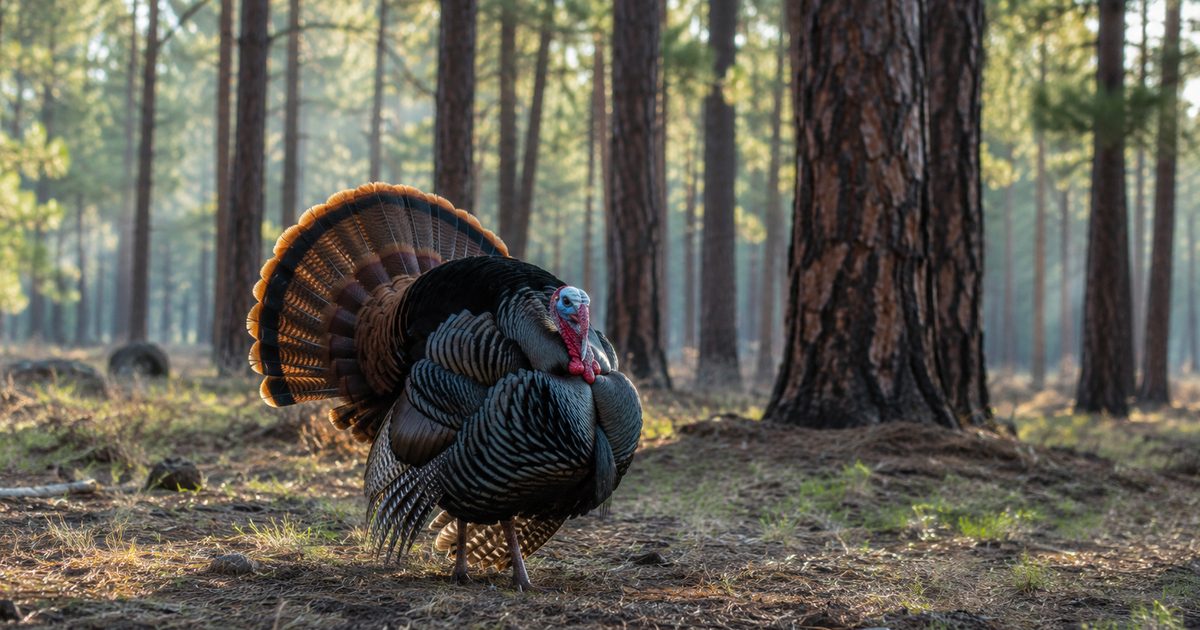
Most turkey hunters think of Arizona as an elk and deer state. That’s understandable — the big game draw system and world-class bull elk dominate the conversation. But tucked into the ponderosa pine plateaus between 6,500 and 9,000 feet, Arizona holds one of the purest, least-pressured Merriam’s turkey populations in the West. Hunters who know about it treat it as one of the best-kept secrets in spring hunting.
Merriam’s are the mountain turkey — built for altitude, adapted to open timber rather than dense bottomland brush, and behaviorally different from the Eastern and Rio Grande birds that dominate turkey hunting culture. If you’ve hunted turkeys in the South or Midwest and expect the same approach to work here, you’ll be surprised. The rules change at 8,000 feet in ponderosa pine.
This guide covers Arizona’s spring season structure, draw vs. OTC tags, the best national forest units, and the calling and scouting tactics that work in open pine terrain.
Quick Facts: Arizona Merriam’s Turkey Hunting
| Detail | Info |
|---|---|
| Subspecies | Meleagris gallopavo merriami |
| Primary Habitat | Ponderosa pine, mixed conifer, 6,500–9,000 ft elevation |
| Spring Season | Mid-April through mid-May (dates vary by unit and hunt type) |
| Tag Types | Limited draw tags (general season) + OTC archery/muzzleloader |
| Draw System | Arizona linear bonus points (same as big game) |
| Application Deadline | February 3 in 2026 (verify current year at azgfd.com) |
| NR Tag Cost | ~$107 (turkey tag) |
| Key National Forests | Apache-Sitgreaves, Kaibab, Coconino, Prescott |
| Trophy Marker | White-tipped tail feathers (Merriam’s signature) |
| Best Scouting Months | February–March (pre-season water source checks) |
Disclaimer: Season dates, tag costs, and regulations listed here were accurate as of early 2026. Arizona Game and Fish Department updates these annually — always verify current rules at azgfd.com before applying or hunting.
Why Arizona Merriam’s Are Considered Trophy Birds
Among hunters pursuing the Grand Slam — all four North American subspecies — Arizona Merriam’s are consistently cited as the most visually striking bird. The reason is the tail fan. Merriam’s carry pure white or cream-colored tips on the tail feathers and rump feathers, a stark contrast to the dark chestnut-brown band of the Eastern or the tan-buff tips of the Rio Grande. A mature Merriam’s tom fanned out in morning sun against ponderosa bark is something you don’t forget. That white tail band is not a subtle field marker — it’s a defining characteristic of the subspecies.
Beyond appearance, Merriam’s are trophy birds because they are harder to pattern than their eastern counterparts. They live in open, park-like timber at elevation where sound carries differently, cover is sparse, and the eastern calling playbook doesn’t transfer cleanly. A hunter who pulls off a successful Merriam’s setup — calling a bird across a hundred yards of open pine park — has earned it through adaptation rather than formula.
A mature Arizona Merriam’s tom will weigh 20 to 24 pounds with a beard of 9 to 11 inches and spurs pushing 1 to 1.25 inches. Solidly respectable metrics on one of the most beautiful subspecies in North America.
Arizona’s Turkey Season Structure
Arizona runs two primary categories of spring turkey hunting: limited-draw general season tags and over-the-counter opportunity through archery and muzzleloader hunts.
Limited draw tags cover the main rifle and shotgun spring seasons, running approximately from the third week of April through mid-May. These are the most coveted tags — they cover the peak gobbling period, and shotgun or rifle setups allow for more margin on moving birds in open timber. Draw odds for most turkey units are favorable: many units draw at 40% to 75% for residents and 30% to 60% for nonresidents depending on unit and year.
Over-the-counter archery and muzzleloader tags give hunters a path to the field without the draw. OTC spring archery tags are available statewide and access the same national forest habitat. The challenge is that bow hunting Merriam’s in open timber — where a bird can spot movement at 60 yards — is a significant difficulty upgrade from shotgun or rifle hunting in denser cover.
Pro Tip
If you’re a nonresident planning your first Arizona Merriam’s hunt and draw odds feel uncertain, buy a bonus point every year you don’t apply for a specific tag. Arizona’s linear bonus system rewards patience — a hunter with 5 points has 6 weighted entries compared to 1 for a first-year applicant. Most turkey units draw in the 1–4 point range for nonresidents, making the wait short relative to big game.
The Best Units: Where to Hunt Merriam’s in Arizona
Arizona’s Merriam’s range tracks closely with its ponderosa pine belt — the elevated plateau country running from the White Mountains northwest to the Kaibab Plateau. National forest land is the primary hunting ground with generally excellent access.
Apache-Sitgreaves National Forest (Units 1–5) is the heart of Arizona Merriam’s country. The White Mountains encompass nearly 2 million acres of ponderosa pine and mixed conifer between 6,000 and 9,500 feet with the state’s strongest bird densities. Units 1, 2, and 3 cover the core of the forest with solid road access and multiple drainages that concentrate birds pre-season. Scale is the advantage — there’s enough country that moderate draw pressure doesn’t saturate the birds.
Kaibab Plateau (Units 12A, 12B) sits at 8,000 to 9,200 feet north of the Grand Canyon. Few hunters associate the Kaibab with turkey, so birds here see less pressure than in the White Mountains. Draw odds are favorable for first- and second-year nonresident applicants. Late-breaking spring at this elevation means green-up is less advanced when the season opens, improving bird visibility in the timber.
Coconino National Forest (Units 6A, 7, 8) surrounds Flagstaff at 7,000 to 8,500 feet. Units 6A and 7 carry local hunter pressure. Unit 8 toward the Mogollon Rim is the better DIY option — more public land, fewer hunters, and birds concentrating near water sources along the Rim edge.
Prescott National Forest (Units 21A, 22) is the southwestern edge of Merriam’s range at 5,500 to 7,500 feet. Bird densities are thinner but draw odds are the most favorable in the state. For a nonresident aiming to draw with zero or one point, Prescott-area units are the most accessible entry point.
Warning
Arizona turkey regulations separate hunt numbers carefully — the same game management unit will often have multiple hunt numbers covering different weapon types and season dates. When applying, confirm you are selecting the correct hunt number for your weapon and target dates. Selecting a muzzleloader hunt number when you intend to hunt with a shotgun is a disqualifying error. Read the current AZGFD regulations carefully before submitting your application.
Merriam’s Biology and Spring Behavior
Understanding how Merriam’s turkeys behave differently from Eastern and Rio Grande birds is the foundation of successful hunting in Arizona.
Merriam’s are nomadic. More than any other North American subspecies, Merriam’s move seasonally with elevation. Birds that winter at 5,000 to 6,000 feet push up to 7,500 to 9,000 feet as spring green-up progresses. A flock that scouted perfectly in early March may shift a mile uphill by late April. Pre-season scouting should focus on the birds’ expected spring range, not their winter location.
The ponderosa habitat shapes everything. Eastern turkeys use dense bottomland cover where sound doesn’t travel far. Merriam’s live in open, park-like ponderosa stands where visibility can extend 200 yards and sound carries clearly in thin mountain air. A tom on a good morning can gobble from half a mile away and you’ll hear it distinctly. That same open timber means he can see you as well as you can see him — the core tactical difference from eastern hunting.
Morning strutting zones. Merriam’s toms fly down from roost pines to open park-like flats or meadow edges to strut. These strutting grounds — identifiable by tracks, wing-tip drag marks, and droppings — concentrate within 50 to 200 yards of roost trees. Locating them before the season is as valuable as finding the roost itself. Birds return to the same areas morning after morning when undisturbed.
They roost on the high points. Merriam’s often roost in the tallest pines on canyon rims, plateau edges, and ridge tops. Roost sites are consistent and can be located by listening for fly-up cackles at dusk or scanning for white-washed bark below large pines. Roosted birds gobble readily at dawn and at locator calls — owl hoots, coyote howls — making tree location straightforward if you’re in the right area at first light.
Calling Tactics for Open Ponderosa Terrain
Merriam’s calling is different from Eastern turkey calling in ways that will frustrate hunters who learned their craft in the South or Midwest. The rules change when you’re in open timber at 8,000 feet.
Call less, not more. The single biggest mistake hunters bring from Eastern turkey hunting to Merriam’s country is overcalling. In dense hardwood bottoms, aggressive calling can pull reluctant birds because they can’t see far enough to expect the hen to come to them. In open ponderosa, a tom at 150 yards can scan the entire area around your calling position and see no hen — and the absence of the visual hen makes him reluctant to commit. More calling often confirms something is wrong, not right.
Set up visible. Decoys matter more in Merriam’s country than in most turkey hunting situations. A hen or feeding hen/jake combination placed 20 to 30 yards in front of your position gives an approaching tom the visual confirmation the calling should be generating. Without it, many birds hang up at 60 to 80 yards — well within gobbling distance but not committed to closing. For a deeper dive on calling sequences and decoy setups, the turkey calling complete guide covers Eastern and western approaches in detail.
Sound travels farther at elevation. In thin mountain air, a box call or slate call carries noticeably farther than at lower elevation. Locator calls can shock-gobble roosted birds from 400 yards. When birds are gobbling but not moving, soft feeding clucks and irregular purrs simulate a hen that is content and occupied — not urgently summoning. Slow, patient calling at close range converts hanging birds better than any other approach in Merriam’s country.
Aggressive calling works during peak gobbling. The exception is the peak gobbling window from roughly April 20 through May 5. Toms in active breeding competition will respond to cutting, fighting purrs, and loud yelping. Match a bird’s energy if he’s coming — go quiet and slow if he’s passive and hanging.
Pro Tip
In open ponderosa timber, position yourself with a large ponderosa pine directly at your back. The trunk breaks your outline and provides a backdrop that prevents the bird from silhouetting you against sky as you draw or raise a shotgun. Sitting against a brushy shrub that provides lateral concealment matters far less in Merriam’s country than having solid backdrop cover from the direction the bird will approach.
Water Source Hunting: An Arizona-Specific Tactic
The southwestern ponderosa zone is semi-arid. Natural water sources are scarce, scattered, and highly predictable — which makes them one of the most reliable tools in an Arizona turkey hunter’s kit. In late April and May, before monsoon rains arrive, birds concentrate around tanks, springs, and developed water sources on national forest land.
Locating these sources on pre-season scouting trips — or via satellite imagery and Forest Service maps — can be as productive as roost scouting. A reliable spring or stock tank in prime habitat will carry obvious turkey sign: muddy tracks, wing-tip drag marks near the edge, feathers, and droppings. A bird that uses a water source once returns reliably.
Set up concealment within 30 to 50 yards of the water and call softly. This approach works especially well from mid-morning through early afternoon after the gobbling period ends — a window many hunters write off as dead time. Water source hunting distinguishes an Arizona spring hunt from turkey hunting almost anywhere else in the country.
Resident vs. Nonresident Tag Availability
Arizona allocates approximately 10% of limited-draw turkey tags to nonresidents in most units. For turkey, that allocation still translates to meaningful draw odds — Arizona turkey isn’t contested the way elk or bighorn are. Nonresidents draw their first or second choice with 0 to 3 bonus points in the majority of units. Note that nonresidents must hold a valid Arizona hunting license alongside the application, and the nonresident combination license adds to the tag fee.
Residents pay significantly less and compete in a proportionally larger pool. Residents applying annually with the linear bonus system draw premium turkey units in the 2- to 5-point range in most years.
For a full breakdown of how Arizona’s draw system works, the Arizona Draw Odds Guide covers the mechanics in detail. If you’re hunting multiple western states, the New Mexico Turkey Hunting Guide covers Rio Grande turkey across the state line — a different subspecies worth stacking into a spring road trip.
What to Expect: Elevation, Weather, and Logistics
Hunting at 6,500 to 9,000 feet in late April means genuinely variable conditions. The ponderosa pine belt in Arizona sits in a climatic transition zone — spring storms can drop several inches of snow overnight in late April, followed by warm, sunny afternoons two days later. Pack accordingly.
Gear considerations at elevation: Pack insulated base layers for pre-dawn temperatures that routinely hit 20 to 30°F at 8,000 feet. Bring rain gear rated for wet snow — the common spring precipitation in this elevation band. Microspikes for icy trail approaches and trekking poles for the rocky ponderosa forest floor are both worthwhile additions.
Forest road access is generally solid in the Apache-Sitgreaves and Coconino, but spring mud and snow can make secondary roads impassable without high-clearance 4WD. Check road conditions with the relevant ranger district before committing to a remote camp. The Kaibab Plateau is particularly sensitive — forest roads can remain closed through mid-April in heavy snow years.
Dispersed camping is allowed throughout the national forest zones with standard fire and sanitation rules. Fire restrictions often activate at higher elevations by late spring — confirm current status before your trip.
Draw Odds Context and Application Strategy
Arizona turkey units draw at 30% to 70% odds for nonresidents with 0 to 3 points in most White Mountains, Kaibab, and Coconino units. The premium early-season units draw tighter, but even competitive turkey units rarely require more than 4 to 5 points to draw with high probability — a far shorter wait than any big game species in the state.
First-year applicants should target a moderately popular unit in the Apache-Sitgreaves or Coconino where 0-point odds run 20% to 40%. With even one point, odds improve enough that most hunters draw within 2 to 3 application cycles.
For nonresidents already accumulating Arizona big game points, the turkey draw is a low-cost addition ($107 tag) that fills spring season without affecting any other point strategy.
Use the Draw Odds Engine to check current applicant numbers and historical success rates for specific units before finalizing your application.
FAQ
Does Arizona have OTC turkey tags or is it all draw?
Arizona has both. Limited draw tags cover the main rifle and shotgun spring seasons. Over-the-counter archery and muzzleloader tags are available statewide and provide access to the same national forest land without the draw. OTC archery is the standard fallback for hunters who blank in the draw and still want to hunt that spring.
How are Arizona Merriam’s different from Eastern or Rio Grande turkeys?
Merriam’s live in open ponderosa pine at elevation, which changes their behavior and calling responses. They’re more nomadic than Easterns, they respond poorly to overcalling in open timber where a tom can see there’s no hen, and their white-tipped tail feathers make them the most visually distinctive of the five North American subspecies. Grand Slam hunters specifically target Arizona birds for that tail fan.
What points do nonresidents need to draw an Arizona turkey tag?
Most Arizona turkey units draw for nonresidents within 0 to 4 points. Turkey is not competitive by Arizona big game standards — nonresidents applying annually will draw their target unit within a few seasons. Check the Draw Odds Engine for specific unit data.
Can I hunt turkeys on national forest land without a guide?
Yes. The Apache-Sitgreaves, Kaibab, Coconino, and Prescott national forests are open to public turkey hunting under a valid Arizona tag. No guide required. The exception is designated wilderness areas, where motorized vehicles are prohibited — foot access only in those zones.
When is the peak gobbling period in Arizona?
The peak window runs roughly April 20 through May 5 in most units, depending on elevation and the year’s green-up pace. Toms are most vocal from 30 minutes before sunrise through 10 AM. Water source hunting becomes productive mid-morning as birds shift out of active breeding behavior and into their feeding and loafing phase.
Plan Your Arizona Merriam’s Turkey Hunt
- Arizona Draw Odds Guide — Full Arizona application breakdown, bonus point mechanics, and multi-species strategy
- Turkey Calling Complete Guide — Calling sequences, decoy setups, and subspecies-specific tactics
- New Mexico Turkey Hunting Guide — Rio Grande turkey across the state line for a western turkey comparison
- Draw Odds Engine — Check historical draw odds for specific Arizona turkey units
- Hunt Unit Finder — Compare Arizona turkey units by habitat, access, and odds
Next Step
Check Draw Odds for Your State
Tag-level draw odds across 9 western states — filter by species, unit, weapon, and points. Free to use.
Get the Insider Edge
Join hunters getting exclusive draw odds data, gear deals, and weekly hunt planning tips.
Related Articles

Arizona Unit 36 Border Country Guide
Units 36A, 36B, and 36C sit along the Mexican border west of Nogales — overlooked Coues and javelina country with low draw requirements and solid hunting.

Montana General Elk Tag: Everything You Need to Know
The Montana general elk tag explained — who can buy one, what it covers, best districts, season dates, nonresident options, costs, and tactics for public land.

Arizona Unit 22 Guide: Tonto Basin
Unit 22 runs across the Tonto Basin and the Salt River country — productive elk in the highlands, accessible javelina in the desert, and some of Arizona's most underrated deer country.
No comments yet. Be the first to share your experience!