Waterfowl Hunting: Duck and Goose Guide for All Hunters
Complete waterfowl hunting guide — duck and goose species identification, decoy spreads, calling, shotgun and choke selection, public land hunting marshes and river systems, and retrievers.
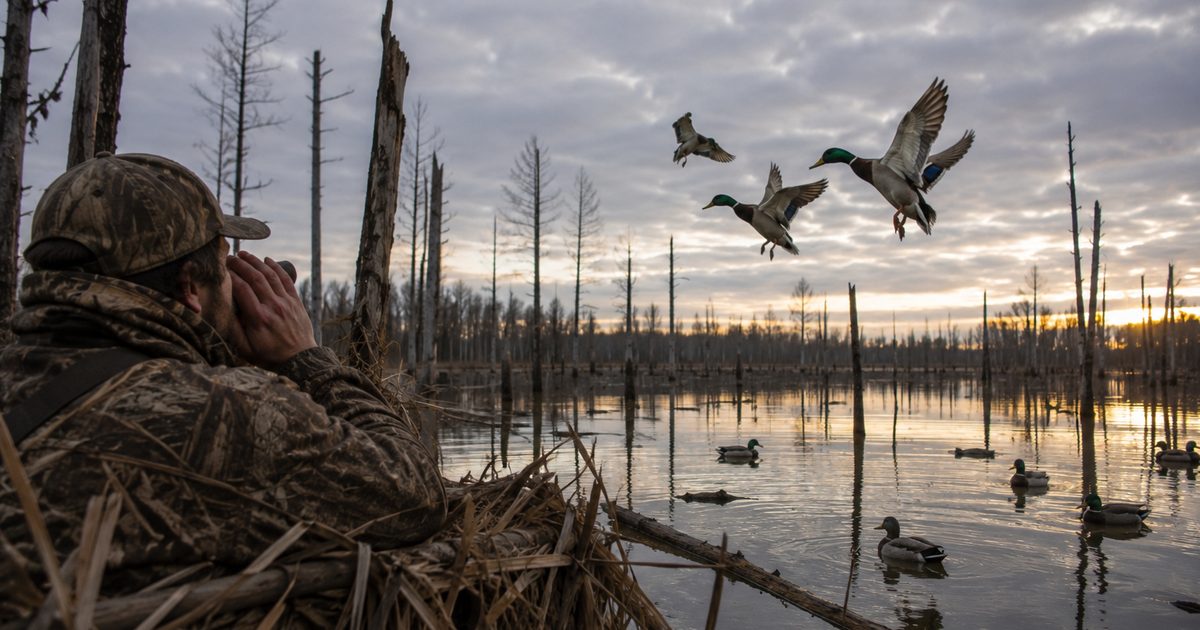
There is a reason waterfowl hunters set alarms for 3 a.m. and wade into dark marshes before the sky even hints at gray. When a flock of mallards drops through the fog with wings cupped and feet down, locked onto your spread, there’s nothing else like it in hunting. But that moment doesn’t happen by accident — it takes the right location, the right decoys, and the right calls at the right time.
This guide covers the full picture: major duck and goose species, seasonal timing, decoy spread design, calling fundamentals, shotgun setup, blind construction, and public land access. Whether you’re setting up your first rig or troubleshooting a spread that birds keep flaring off of, there’s something here worth taking into the field.
Know the Birds You’re Hunting
Waterfowl hunting is not one-size-fits-all. Mallards, teal, pintails, and diving ducks all behave differently, use different habitat, and respond to calls and decoys in ways that require separate tactics. Grouping them all under “ducks” is like calling elk and whitetail the same animal.
Mallards
The mallard is the benchmark species — loud, visible, and widely distributed across every major flyway. Drakes carry the iconic green head and chestnut breast; hens are mottled brown with an orange-sided bill. Both produce the classic quacking sound, though it’s the hen that makes the loud, descending greeting call most hunters imitate.
Mallards are puddle ducks. They tip-feed in shallow water, loaf on exposed sandbars, and roost on calm backwaters. They respond well to a large spread — 18 to 36 decoys in calm conditions — and they want to see movement. Jerk cords, ripple stakes, and spinning-wing decoys all work in early season. By late season, after birds have been pressured for two months, the spinning-wing can actually flare educated birds. Read the flock. If they’re pumping their wings on the approach and circling wide, pull the spinner.
Teal
Blue-winged and green-winged teal are the speed demons of the marsh. They migrate early and fast — blue-wings are often gone before the main season opens in many states, which is why most states offer a dedicated early teal season in September. Green-wings filter through later and push south with the first hard cold fronts.
Teal work best with a small, tight spread — 12 decoys in a close cluster mimics a feeding group, and teal pile in with almost no convincing. They respond to high-pitched feeding chuckles more than the standard greeting call. Their small bodies and blazing speed demand that you lead them more than feels natural. On crossing shots, double your perceived lead.
Pintails
Northern pintails are the greyhounds of puddle ducks — long-necked, elegant, and notoriously call-shy. They’re wary birds that circle at altitude and look hard before committing. Pintails respond to a softer, slower calling cadence and want to see realistic decoys with proper body posture. If birds are circling but not finishing, look at your spread from the birds’ angle. A tangled cluster of decoys or a visible wad of anchor line will push pintails off every time.
Diving Ducks
Canvasbacks, redheads, scaup, and ring-necks are built for open water. They dive rather than tip-feed, and they congregate in large rafts on lakes, reservoirs, and coastal bays. Hunting divers means hunting from a boat blind or layout boat on open water, or from a permanent blind on a point or shoreline.
Diver decoys work best in large numbers — 50 to 200 decoys in a long string or raft pattern with a landing hole cut into the upwind side. Divers don’t respond to the same calling sequences as puddle ducks. A soft, subtle two- or three-note call is enough. The spread itself does most of the work.
Goose Hunting: Canada, Specklebelly, and Snow Geese
Geese offer some of the most accessible and highest-volume waterfowl hunting available, particularly when birds are staged on agricultural fields during migration.
Canada Geese
Giant Canadas are the most widely hunted goose in North America. They’ve adapted so thoroughly to suburban and agricultural environments that many states now have early resident goose seasons before the main waterfowl season to manage local populations. Honkers are social, vocal birds that work well to decoys and respond to confident calling.
Field hunting with layout blinds is the dominant tactic when birds are feeding in harvested corn, soybean, or wheat fields. A spread of 24 to 48 full-body decoys in a loose, natural-looking cluster with a clear landing lane into the wind gives birds exactly what they want to see. Canada goose calls are lower and slower than duck calls — practice the honk, the double-cluck, and the laydown call that fires up a flock working a field from half a mile.
Specklebellies
The white-fronted goose — specklebelly in hunting vernacular — is a highly regarded table bird with a complex, laughing call that’s one of the most satisfying to replicate. They migrate through the Central and Pacific flyways in significant numbers and are often mixed into Canada goose fields.
Specklebellies are flightier than Canadas. They respond to a high-pitched, two-syllable “ka-luk ka-luk” call. When you have a flock working close, aggressive calling often pushes them off — go quiet and let the decoys do the work once birds are inside 100 yards.
Snow Geese
Light geese — snows, blues, and Ross’s geese — migrate in numbers that have to be seen to be believed. Snow goose hunting has its own culture: enormous spreads of 300 to 1,000 white decoys (socks, rags, or full-bodies), electronic callers legal during the spring conservation order, and layout blinds in picked cornfields. The conservation order runs after the regular season closes with relaxed restrictions to help manage populations that have grown large enough to damage Arctic nesting habitat.
The Flyway System and Migration Timing
The U.S. Fish and Wildlife Service manages waterfowl through four flyways: Atlantic, Mississippi, Central, and Pacific. Seasons and bag limits are set flyway by flyway and differ substantially even within the same flyway — a Minnesota hunter and a Louisiana hunter are operating under different rules despite birds from the same breeding grounds passing through both states.
Migration timing is driven by weather and photoperiod. Cold fronts and ice conditions determine how fast birds move and how far south they push. The best hunting typically happens in the two weeks after a major front. Watch weather to the north — a hard freeze in Manitoba means good hunting in the Dakotas 48 hours later.
Scouting for X
The most important thing you can do to improve your waterfowl hunting is scout birds to a specific location. You’re looking for the X — the exact field, pond, or backwater where birds are actively feeding or resting right now.
Birds are creatures of habit during migration staging, using the same loafing areas and feeding fields repeatedly — but not indefinitely. Fresh sign each morning tells you whether birds are still in the area. Drive roads adjacent to agricultural fields before first light and listen. Watch for birds trading at first light and mark where they land. A marsh with 200 mallards yesterday may be empty today if a cold front pushed them south overnight. Find birds fresh every day.
Pro Tip
Mark loafing and feeding locations with pins the evening before your hunt. Birds often return to the same pond or field at first light, but the landing zone shifts with wind direction. Arrive an hour early to set decoys before shooting time — it’s standard, not optional.
Decoy Spread Design
How you arrange decoys matters more than the number of decoys in most situations. Birds are looking for a natural-looking group with an obvious landing zone into the wind.
The J-Hook and U-Shape
The two most proven puddle duck layouts are the J-hook and the U-shape. Both designs create a clear pocket of open water where birds can land, positioned downwind of the blind. Birds approach into the wind — the same direction they want to land — so the pocket should be directly in front of your shooting position.
In the J-hook, a long string of decoys curves around to one side, with the hook creating the landing zone at the tip. In the U-shape, two wings of decoys angle away from an open center pocket. Both designs work. In heavy current or tight backwaters, a simple two-cluster layout (a loafing group and a feeding group with open water between) achieves the same result with fewer decoys.
Motion Decoys
Motion sells the spread when birds are nearby and looking hard. Spinning-wing decoys — Mojos and similar — are extremely effective early in the season when birds haven’t been pressured. By December in a heavily hunted area, educated birds associate spinning wings with danger. Keep a spinning-wing in your rig but be prepared to pull it if birds are flaring.
Jerk cords, which create ripple movement in a surface decoy, work throughout the season with no late-season burnout. A single hen mallard on a jerk cord in calm water does more than six static decoys.
Warning
Running a spinning-wing decoy is illegal in some states and during certain seasons. Check your state regulations before using motion decoys — rules vary by state and some prohibit them entirely after a specific date or for specific species.
Duck Calling Fundamentals
The standard duck call is a single-reed acrylic or wood call designed to replicate the mallard hen. It’s the most versatile tool in a waterfowl hunter’s vest, but it’s also the most abused. Overcalling flares far more birds than undercalling ever will.
The Core Sequences
The six-note greeting call is the foundation. It’s a loud, confident sequence used to get a distant flock’s attention — a high-pitched “hail call” designed to carry. Use it when birds are 200-plus yards out and flying away.
The feed chuckle is a rapid, staccato series of short notes: “tika-tika-tika-tika.” It mimics a group of birds actively feeding and communicating. Use it once birds have turned and are working toward you — it reinforces that the area is safe and food is present.
The comeback call is an urgent, fast series used when birds commit, then flare or veer off. It’s aggressive — louder than normal — and designed to pull them back before they’re gone. If birds are circling at 150 yards and look undecided, a hard five- to seven-note comeback can snap them back into working range.
When to Stop Calling
When birds are committed and dropping into the decoys, stop calling entirely. Calling at birds that are already locked in gives them something to focus on, and if your call isn’t perfect, they’ll flare. Let the decoys close the deal.
Shotgun and Ammunition Selection
All waterfowl hunting in the United States requires non-toxic shot. Lead is prohibited for any duck or goose hunting.
Warning
Using lead shot for waterfowl is a federal violation. Steel, bismuth, tungsten, and other approved non-toxic shot are required by law. Additionally, steel shot requires an open choke — Modified or more open for standard steel loads. Using a Full or Extra Full choke with steel shot risks damaging or destroying your barrel. Check both your shot material and your choke before loading up.
Steel Shot and Shell Selection
Standard steel shot in 2 or 3 shot size handles most puddle duck hunting out to 40 yards. For geese or late-season mallards with dense plumage, step up to BB or BBB steel in 3-inch or 3.5-inch shells. Higher-density alternatives like bismuth and tungsten-based loads pattern better and carry more energy at longer ranges — they’re significantly more expensive but worth considering for hunting situations that demand 45- to 50-yard shots.
A 12-gauge with a 3-inch chamber handles 95 percent of waterfowl hunting scenarios. A 3.5-inch magnum 12-gauge gives an edge for late-season geese and high-passing snow geese, but the added recoil and cost may not justify the upgrade for most hunters.
Choke Selection for Steel
For standard steel loads, use an Improved Cylinder or Modified choke — never Full or Extra Full. Some manufacturers produce chokes specifically rated for steel shot in Modified or Light Modified constrictions that offer tighter patterns than standard Modified while remaining safe. Read your choke tube’s labeling — if it doesn’t specifically say it is steel-rated at that constriction, don’t risk it.
Hunting Blinds and Concealment
Concealment in waterfowl hunting is non-negotiable. Ducks and geese have exceptional eyesight and will flare from a hunter’s face or an uncamouflaged blind at 80 yards. Your blind doesn’t need to be elaborate — it needs to break up your outline and match the surrounding vegetation.
Layout blinds fold flat and allow a hunter to lie on their back in a harvested field, completely invisible from above. They’re standard for field goose hunting and late-season field ducks.
Pit blinds are permanent or semi-permanent pits dug into a field, allowing hunters to stand at ground level. They require landowner permission and upfront effort but provide unmatched concealment.
Boat blinds attach to a flat-bottomed boat and allow hunters to work river systems and shallow marshes with mobility — repositioning between flights rather than waiting in a fixed location.
Natural vegetation blinds — cut cattails, willow branches, or marsh grass woven into a frame — blend into the environment when brushed in aggressively. If you can clearly see the blind’s edges, so can the birds.
Public Land Waterfowl Hunting
Access is often the biggest obstacle for waterfowl hunters, but public opportunities are more extensive than most people realize. For a full breakdown of navigating public land, the guide at /articles/hunting-public-land-complete-guide covers access strategies across multiple species and land types.
National Wildlife Refuges (NWRs) are specifically managed for migratory birds. Many NWRs allow hunting in designated zones under a refuge-specific permit or self-registration system. Some — like Malheur in Oregon or Agassiz in Minnesota — draw hunters from multiple states.
State Wildlife Management Areas (WMAs) with wetland units or managed impoundments offer consistent opportunities across every flyway. State agencies actively manage water levels to concentrate food and loafing habitat, and bird numbers during migration pushes can be exceptional.
River systems and backwaters are the overlooked public option. Navigable rivers are public water in most states, and the oxbows and timber backwaters along major flyway rivers — the Mississippi, Missouri, Arkansas — hold mallards, wood ducks, and divers throughout the season with almost no pressure.
The Value of a Retriever
A well-trained retriever isn’t a luxury — it’s a functional tool that directly improves your recovery rate. Crippled birds that land in dense marsh grass or open water 80 yards out are a regular part of waterfowl hunting. Without a dog, many of those birds are lost.
Labradors are the standard: built for cold water, capable of marking and retrieving multiple birds, and steady in a working blind without flushing the next flock. Chesapeake Bay retrievers and goldens are solid alternatives. A young dog with 6 months of solid obedience and retriever foundation will outperform any untrained dog of any breed.
The guide at /articles/hunting-dog-training-complete-guide covers foundation training, force-fetch, and steadiness in detail. Start early and you’ll have a hunting partner for twelve to fifteen seasons.
FAQ
What is the best choke for duck hunting with steel shot?
Use an Improved Cylinder or Modified choke rated for steel shot. Most waterfowl loads pattern well through Improved Cylinder at typical duck distances of 25 to 40 yards. Never use Full choke with steel — it can cause dangerous pressure spikes and damage your barrel.
How many decoys do I need to start duck hunting?
A dozen to eighteen mallard decoys is enough for most puddle duck water. Spread them in a J-hook or U-shape with an open landing pocket downwind. More decoys help in open water or for divers, but hunters consistently kill limits with small spreads in the right location.
When is the best time to call ducks?
Use a loud greeting call when birds are far away. Transition to a feeding chuckle as they work closer. Stop calling when birds are locked in and dropping — the most common mistake is calling at birds that are already committed. Let the decoys close the deal.
Can I hunt ducks on public land without a boat?
Yes. Many WMA marshes have walk-in access along dikes and levees. River backwaters can be hunted from the bank or waded if water levels allow. Check WMA maps for zone boundaries and access points before the season.
What is the conservation order for snow geese?
The Light Goose Conservation Order extends the snow goose season beyond the regular waterfowl season with relaxed rules — including electronic callers and unplugged shotguns. It runs late February through April in most flyway states and is specifically designed to reduce overabundant snow goose populations damaging Arctic nesting habitat.
Next Step
Check Draw Odds for Your State
Tag-level draw odds across 9 western states — filter by species, unit, weapon, and points. Free to use.
Get the Insider Edge
Join hunters getting exclusive draw odds data, gear deals, and weekly hunt planning tips.
Related Articles

Arizona Elk Calling: September Archery
September archery elk in Arizona means calling. Here's the practical guide to bugles, cow calls, and the timing that produces bulls.
Arizona Hound Hunting Regulations Guide
Arizona hound hunting for bear and lion requires specific permits and tags. Here's the complete regulatory guide for 2026.

Arizona Shed Hunting: Rules & Season Guide
Arizona has specific rules on shed antler collecting. Here's the complete guide to the season, the ethics, and the most productive areas.
No comments yet. Be the first to share your experience!