Hunting Dog Breeds: Which Dog for Which Hunt
Hunting dog selection guide — flushing dogs vs pointing dogs vs retrievers vs hounds, the best breeds by hunting application (waterfowl, upland, deer tracking, bear/lion), and how to choose the right dog for how you actually hunt.

The right hunting dog doesn’t just improve your hunt — for certain applications, it’s the difference between going home empty-handed and walking out with game. If you are planning a western public land hunt where a dog might join you, use the Tag-to-Trail Planner to map logistics including access and terrain before you go. A Lab that marks a triple on a December duck marsh and swims back through breaking ice is doing something no amount of wading boots and a long stick can replicate. A Beagle that puts a rabbit in a tight circle back past your stand is working a system you couldn’t replicate on your own. A pointing dog frozen solid 40 yards out in a Kansas wheat stubble field, holding a covey of quail while you close the distance — that’s a partnership built over years of work, and it’s irreplaceable.
But “hunting dog” covers a huge range of animals, work styles, and hunting applications. The Lab that excels on ducks will frustrate you in thick upland cover where a Springer Spaniel belongs. The Walker Hound that runs bear through mountain timber is not the dog you want trying to heel through a duck blind. Matching dog to hunt type is the foundation of the whole thing.
This guide breaks down the four major functional categories — retrievers, pointing breeds, flushing spaniels, and hounds — plus the growing tradition of tracking dogs for wounded big game. For each group, we cover the top breeds, what they do well, and where they fall short.
Retrievers: Water Work and the Hunting Lab
Retrievers are built around one job: finding downed game and bringing it back to hand. For waterfowl hunters, this is the entire point. A duck that falls in open water, a flooded marsh, or a timber hole without a dog is often a lost duck. Retrievers close that gap.
Labrador Retriever
The Lab is the most popular hunting dog in America by a wide margin, and it earned that status. Labs combine a water-loving temperament, a thick double coat that insulates against cold water, powerful swimming drive, soft mouth, and an almost unshakeable desire to retrieve. A trained Lab will mark multiple falls simultaneously — watching each bird drop and remembering the location — then retrieve them in sequence on command. In a late-season teal or mallard hunt in 35-degree water with chunks of ice moving through, a Lab is working conditions that would stop a lesser dog in minutes.
Labs are also legitimately versatile. Many hunters run their Labs on pheasants and quail with excellent results. They’re close-working flushers in that context — covering ground methodically in front of the hunter, flushing birds into the air, then retrieving the fall. They won’t hold point, but for hunters who don’t want to manage a dog ranging far out in front, a Lab in upland cover is a competent and pleasurable hunting partner.
Golden Retriever
Goldens share the same basic job description as Labs — mark, retrieve, deliver to hand — and are often considered softer in temperament and slightly more trainable for novice handlers. They perform excellently in waterfowl and upland hunting. The trade-off compared to a Lab is that Goldens carry more coat, which can collect burrs and debris in thick cover, and they’re not quite as cold-tolerant in extreme icy conditions.
Chesapeake Bay Retriever
The Chessie is the heavy-weather specialist. Bred specifically for the brutal conditions of Chesapeake Bay duck hunting — cold water, heavy surf, long retrieves, hard birds — the Chesapeake Bay Retriever is the toughest cold-water dog in the retriever group. Their oily, wavy coat repels water in a way that goes beyond what a Lab coat can do. Chessies are also more independent and less biddable than Labs or Goldens, which means they can be harder to train and are typically better suited for experienced dog handlers. When conditions get genuinely punishing, nothing works harder.
Pro Tip
If you’re a first-time hunting dog owner choosing a retriever, start with a Lab from proven hunting lines. They’re trainable, forgiving of handler mistakes, and versatile enough to handle both waterfowl and upland work while you develop your own handling skills.
Pointing Breeds: Finding and Holding Birds
Pointing breeds work differently than retrievers. They range out ahead of the hunter, use their nose to locate upland birds, and then freeze — going rigid on point — when they get close enough to smell them. The dog holds that point, sometimes for several minutes, while the hunter walks in. Only when the hunter is in position does the flush happen, putting birds in the air at close range for a shot. This sequence — find, point, hold, flush on command, retrieve the fall — is what makes pointing dogs so effective on pheasants, quail, chukar, and grouse.
German Shorthaired Pointer
The GSP is arguably the most versatile hunting dog in the world. German Shorthaired Pointers were developed to do everything: point upland birds, track wounded big game, retrieve from water, and work in varied terrain across all seasons. A well-bred, well-trained GSP can hunt ducks in the morning and pheasants in the afternoon. They range aggressively — typically 50 to 200 yards out — which is ideal for open country like Kansas or the Dakotas but can be too much dog for tight woodcock covers in New England. GSPs are athletic, high-energy, and require significant exercise. They make outstanding hunting dogs but demanding pets if you’re not putting them to work.
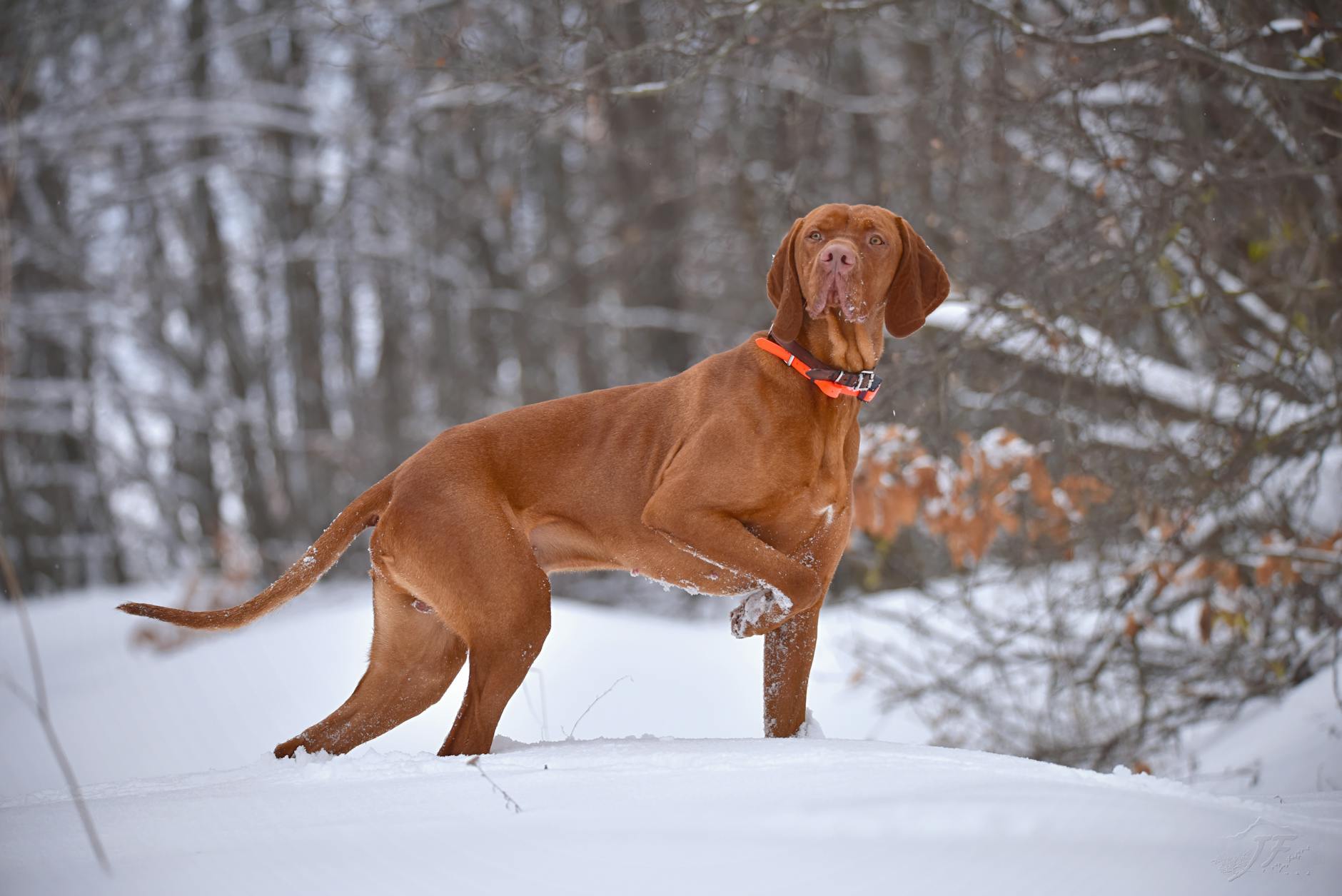
Vizsla
The Vizsla is Hungary’s answer to the versatile hunting dog — similar in concept to the GSP but with a closer working style and a warmer, more affectionate temperament. Vizslas point, retrieve, and work water with genuine enthusiasm. They’re a good choice for hunters who want a pointing dog that also functions as a family companion without needing a separate kennel dog energy level. The trade-off is they’re lighter-framed and less cold-tolerant than a GSP in hard winter conditions.
Brittany
Brittanys were built for dense cover. Where a GSP might range 200 yards in front of you, a Brittany works tight — often 30 to 60 yards — making them ideal for grouse and woodcock in northeastern timber or brushy pheasant fields where you can’t see far ahead anyway. They’re compact, energetic, and highly trainable. For hunters who spend most of their time in thick cover rather than open plains, a Brittany is often a better fit than a wide-ranging pointer.
English Pointer and Weimaraner
The English Pointer is one of the oldest pointing breeds and still dominates field trials. They’re athletes built for speed and wide range — best suited to open country quail and chukar hunting where covering ground fast is an advantage. The Weimaraner, sometimes called the “gray ghost,” is another German versatile breed with a powerful nose and strong retrieving drive. Weims have a strong prey drive and an independent streak that can challenge novice handlers, but experienced hunters report them as exceptional big-game trackers in addition to their upland work.
Flushing Spaniels: Close-Working Cover Dogs
Spaniels work differently from pointing breeds. Instead of finding birds and freezing, spaniels push through cover aggressively, flushing birds into the air in range of the hunter. The hunter’s job is to stay close — typically within 20 to 25 yards — so that when a bird erupts, it’s in range. Spaniels also retrieve reliably and many have solid water instincts.
English Springer Spaniel
The Springer is the benchmark flushing dog. They’re enthusiastic cover workers, crashing through briars and cattail marshes without hesitation, flushing pheasants that a pointing dog might bump prematurely on a running bird. A trained Springer quarters back and forth in front of the hunter in a windshield-wiper pattern, covering ground efficiently within shooting range. They retrieve well and many Springers are comfortable in duck blinds for light waterfowl work. For mixed pheasant and duck hunting, a Springer is a highly competent single-dog solution.
Cocker Spaniel
The American Cocker is smaller than the Springer and built for tighter cover — ideal for woodcock and quail in dense brush where a bigger dog would tear through too aggressively. They’re close workers by nature. The English Cocker Spaniel is a different breed from the show-type American Cocker, and working-bred English Cockers have enjoyed a strong revival among serious upland hunters for their hunt drive and bidability.
Boykin Spaniel
The Boykin was developed in South Carolina specifically for hunting doves and ducks from small boats in tight southern swamps — which tells you everything about what it’s built for. Compact enough to share a canoe without tipping it, with a strong water drive and a soft mouth, the Boykin excels in the Southeast’s flooded timber, beaver ponds, and dove fields. They flush, retrieve, and operate in heat that would slow down a heavier northern breed.
Important
Spaniels require more active handling than pointing breeds. Because they’re working close and fast, if a spaniel gets out of range, birds flush wild. The foundation of spaniel training is “hup” (sit-stay) and steady-to-flush — without those, you’ll be chasing birds into the next county.
Hounds: Following Nose to Quarry
Hound hunting is its own culture, with its own traditions, equipment, and language. Where pointing dogs and retrievers work in front of the gun, hounds work ahead of the hunter and drive quarry to the hunter or tree it. Hound hunters often follow their dogs by sound — listening to the strike, chase, and tree bark from a distance — and the music of a pack of hounds running in timber is something that gets in your blood.
Beagles for Rabbit
Beagles are the rabbit hunter’s dog. Small enough to work through dense briar tangles, with a nose built for ground scent and a voice that carries, a Beagle pushes a rabbit in a circle back past the hunter’s stand. Rabbits are territorial — they rarely run in a straight line. They loop back to familiar ground, which is exactly the behavior a Beagle exploits. Beagles are also one of the most accessible hunting dogs to train and keep, which makes them popular for hunters who want a working dog without the intensity of a high-drive pointing breed.
Coonhounds for Raccoon, Bear, and Mountain Lion
The various coonhound breeds — Black and Tan, Bluetick, Redbone, Walker, Plott — were each developed for tracking game by scent and then treeing or baying it at bay. For raccoon hunting, coonhounds are the tool: they trail the coon by cold scent, often hours-old tracks, and tree it where the hunter can walk in with a light. For bear and mountain lion hunting in states where hound hunting is legal, coonhounds (particularly Plotts and Walkers) are the standard tool. They’re big-game hounds, capable of trailing a lion for miles through mountain terrain and holding it treed long enough for the hunter to get there on foot or horseback.
Plott Hounds deserve specific mention for bear work — the breed was developed exclusively for boar hunting and bear hunting in the Appalachians and is widely considered the top cold-nosed, cold-weather bear dog.
Tracking Dogs: Recovery After the Shot
The tracking dog tradition is well-established in Europe, where hunters are legally obligated to use trained tracking dogs for wounded big game recovery in many countries. In the United States, it’s a growing niche that many serious deer hunters are discovering as a practical recovery tool.
Bavarian Mountain Hound
The Bavarian Mountain Hound is the European specialist built entirely around blood tracking — following the scent of a wounded deer’s blood trail hours or days after the shot. They’re methodical, focused, and will work a track that has gone cold. In Germany and Austria, certified Bavarian Mountain Hounds are used by professional hunters for post-shot recovery, and their use is increasingly popular among serious whitetail and mule deer hunters in the US who want to recover deer that would otherwise be lost.
Bloodhound and Dachshund
The Bloodhound’s scenting ability is legendary — they can follow a days-old human track, and they apply that same ability to wounded deer work. Bloodhounds are large and require an experienced handler, but their tracking precision on a difficult blood trail is unmatched. The Dachshund — often overlooked as a toy dog — was originally bred in Germany as a versatile tracking and den dog. Working Dachshunds from hunting lines are compact, fearless, and highly capable on blood tracks. In southern states, where dense cover makes deer recovery difficult, trained Dachshunds have built a dedicated following among deer hunters.
Matching Dog to Hunt: A Practical Framework
| Hunt Type | Best Match | Why |
|---|---|---|
| Duck / goose / marsh | Labrador, Chesapeake Bay Retriever | Cold water tolerance, marking ability, retrieve drive |
| Pheasant (open fields) | GSP, Springer Spaniel, Lab | Range, flush-and-retrieve, upland nose |
| Quail / chukar (open) | English Pointer, GSP, Vizsla | Speed, wide range, point-and-hold |
| Grouse / woodcock (timber) | Brittany, English Cocker | Close working, tight cover navigation |
| Dove / duck (southern swamps) | Boykin Spaniel | Compact, heat-tolerant, water drive |
| Rabbit | Beagle | Circle tracking, drive, range control |
| Raccoon | Bluetick, Black and Tan, Walker | Cold nose, tree instinct |
| Bear / mountain lion | Plott, Walker, Redbone | Big game drive, toughness, range |
| Wounded deer recovery | Bavarian Mountain Hound, Bloodhound | Blood track specialization, methodical trailing |
The Versatility Question: GSP vs Lab
Hunters who pursue multiple game types often ask: should I get a pointing dog or a retriever? The two breeds most often debated as all-purpose hunting dogs are the German Shorthaired Pointer and the Labrador Retriever.
A Lab is the better choice if waterfowl is your primary pursuit and upland birds are secondary. Labs in water are simply hard to beat, and a well-trained Lab handles pheasants and quail capably even without pointing instinct. They’re also typically easier for first-time gun dog handlers to train and live with.
A GSP is the better choice if upland birds are primary and occasional waterfowl or versatile big-game tracking is in the mix. A GSP will out-hunt a Lab in pheasant fields and is legitimately useful tracking wounded deer — something a Lab’s breeding doesn’t really support. GSPs are higher-energy and require more intensive work, but a seasoned GSP handler will tell you nothing else touches them for an all-day upland hunt. If you are hunting upland birds in the West and need e-scouting help locating habitat and public access, our hunting apps and e-scouting guide covers the mapping tools that make a difference.
The honest answer is that no single dog does everything at the elite level. A hunter who ducks three times a week and upland hunts twice a week is better served by two dogs than by trying to find one breed that splits the difference acceptably.
The Training Commitment Reality
This is the part of gun dog ownership that surprises new owners most. A hunting dog does not come out of the box ready to work. Field-bred puppies from proven hunting lines have strong instincts, but instinct is not training. Converting a pup into a reliable gun dog in the field takes 12 to 24 months of consistent, structured work — basic obedience, introduction to birds and gunfire, force-fetch if retrieving is required, steadying, field work at progressively increasing difficulty.
That means hunting seasons 1 and 2 are largely learning seasons. The dog will make mistakes. You’ll lose birds because of it. That’s part of the deal. The hunters who get the most out of their gun dogs are the ones who commit to year-round training, not just in-season conditioning. Off-season field work — planted bird training, yard drills, water work — is what builds the reliable dog you hunt hard with for the next decade.
If you’re not prepared to put in that training time yourself, working with a professional trainer for at least the first year is money well spent. A dog that’s been through a professional program with a solid foundation is far easier to maintain than one that had to unlearn bad habits.
Bottom Line
Gun dogs are one of the most rewarding investments a hunter can make — and one of the most mismatched when buyers pick based on appearance rather than hunting application. Lead with the question: what do I primarily hunt, and what specific job do I need a dog to do?
Waterfowl hunters belong with a retriever, full stop. Upland hunters in open country get more from a wide-ranging pointing breed. Tight cover hunters are better served by a spaniel. Rabbit and raccoon hunters belong in the hound world. Deer hunters who struggle with recovery should look hard at a trained blood-tracking dog — the investment pays for itself the first time you recover an animal that would have been lost.
Whatever breed you choose, buy from field-proven hunting lines — not show or pet lines — and budget serious time for training. A dog from hunting stock with a year of consistent work behind it will outperform a champion show dog’s offspring regardless of paperwork, every single time in the field. New to hunting with dogs? The hunting for beginners complete guide lays out the full context for building out your first serious hunting setup.
Next Step
Check Draw Odds for Your State
Tag-level draw odds across 9 western states — filter by species, unit, weapon, and points. Free to use.
Get the Insider Edge
Join hunters getting exclusive draw odds data, gear deals, and weekly hunt planning tips.
Related Articles

Arizona Elk Calling: September Archery
September archery elk in Arizona means calling. Here's the practical guide to bugles, cow calls, and the timing that produces bulls.
Arizona Hound Hunting Regulations Guide
Arizona hound hunting for bear and lion requires specific permits and tags. Here's the complete regulatory guide for 2026.

Arizona Shed Hunting: Rules & Season Guide
Arizona has specific rules on shed antler collecting. Here's the complete guide to the season, the ethics, and the most productive areas.
No comments yet. Be the first to share your experience!