Duck Hunting Tactics: Decoys, Calling, and Concealment That Work
Duck hunting tactics guide — decoy spreads for different situations, calling sequences that bring birds in, blind and concealment setup, reading migration and weather, and the adjustments that separate consistent duck hunters from occasional shooters.
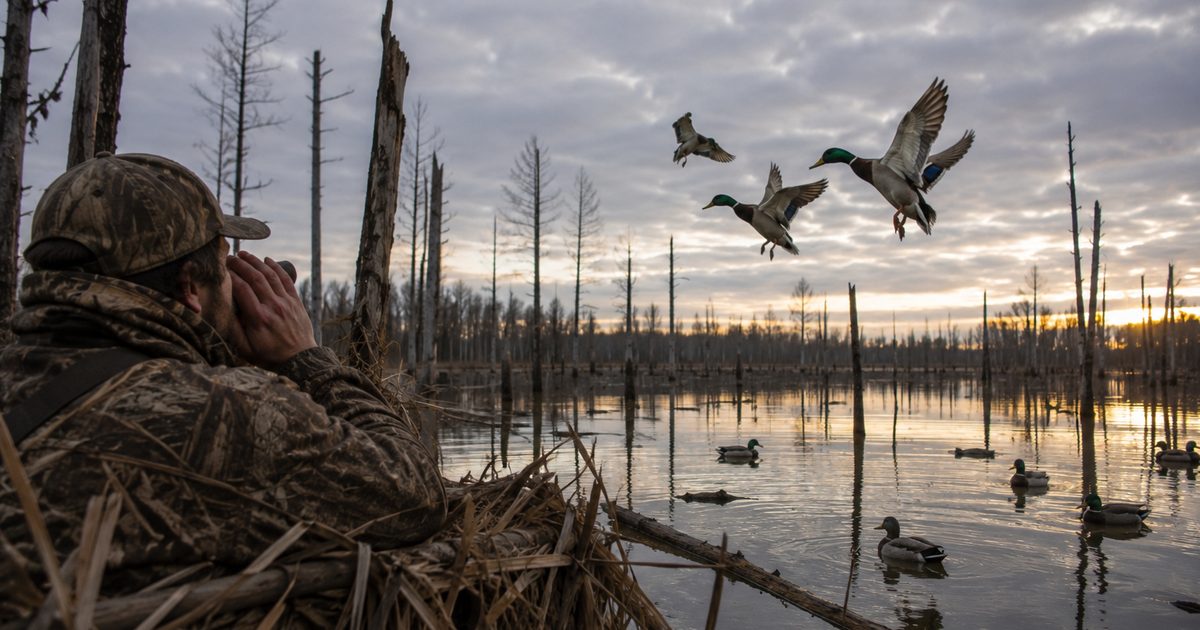
You can have the right shotgun, the right choke, the right load, and a spread that looks straight out of a magazine — and still watch flock after flock swing wide and keep flying. Duck hunting is one of the few pursuits where doing everything right on paper gets you nothing if you can’t read the birds in real time and make the adjustments that actually matter.
Consistent duck hunters share a few habits: they scout before the season and between hunts, they let the birds tell them what the spread needs, they know when to call and — more importantly — when to stop, and they’re obsessive about concealment in ways that newer hunters underestimate. This guide breaks down the tactics side of duck hunting — the decisions and setups that determine whether birds commit or flare — not just a gear checklist.
Reading Ducks Before You Ever Set a Decoy
The single biggest return on investment in duck hunting is scouting. Not guessing where ducks should be based on habitat maps, but physically finding where they want to be right now, in current conditions, with current food sources and water levels. The approach mirrors what effective turkey scouts do — our turkey scouting guide covers pre-season reading of sign and pattern-building that transfers directly to waterfowl.
Ducks are creatures of pattern. They roost somewhere at night and feed somewhere in the morning. If you can identify both ends of that pattern, you can intercept them on the X — the spot they were already going to land, not a spot you’re trying to convince them is worth a detour.
What to look for when scouting:
- Flooded agriculture: flooded corn, milo, rice, and soybeans are magnets. Birds will hammer these areas until the food is gone.
- Loafing areas: calm, open water where ducks rest mid-day. Not typically where you hunt, but tracking loafing spots tells you where birds are concentrated in an area.
- Flight lines: watch where ducks fly at first light. They are creatures of habit and will fly the same routes morning after morning if they aren’t pressured.
- Water edges and timber: mallards especially love flooded timber edges where they can feed on acorns and invertebrates in shallow, protected water.
Pro Tip
Scout the evening before your hunt, not days in advance. Water levels, weather, and bird movement can shift overnight. A field that held 500 birds on Monday might be dry or abandoned by Thursday.
Decoy Spreads That Actually Work
Decoys serve one purpose: convincing birds in the air that other ducks are comfortable on this water. Everything about your spread — the number of decoys, the configuration, the motion — needs to support that illusion. The core principles of what decoys communicate — posture, positioning, and social signals — are covered in depth in the turkey hunting decoy guide, and a surprising amount of that reasoning applies directly to waterfowl setups.
The Landing Zone Is the Whole Point
Ducks don’t commit to a “spread.” They commit to a specific landing zone — a calm, open pocket of water that looks safe and inviting. Your spread creates that pocket. The pocket’s position relative to wind and the sun determines whether birds land exactly where you want them.
Always set your landing zone upwind of your blind so birds approach into the wind and settle toward you, not away. Leave a gap — usually 10 to 15 yards of open water — on the upwind edge of your spread. That’s where they’ll try to land.
Spread Configurations
J-Hook: The most versatile and commonly used layout. The long straight side of the J runs parallel to the wind, and the curve of the J creates the landing pocket at the open end. Birds fly along the straight arm, turn into the wind, and drop into the pocket. Works on ponds, flooded fields, river backwaters, and most mixed situations. Start here if you’re not sure what the conditions call for.
C-Shape (Horseshoe): Similar concept to the J but creates a larger, more open landing pocket in the middle. Better when you have more space and more decoys — 4 dozen or more. The open end of the C faces into the wind. Works well in open flooded fields and big marshes where ducks want more room to commit.
X-Pattern: Used in open water situations, particularly for divers like scaup, bluebills, and canvasbacks. Two lines of decoys crossing in the center with open water at the intersection. Divers like to land in the middle of a large raft rather than on the edge. Set this spread when you’re hunting open lake points or river flats where diving ducks congregate.
Decoy Numbers by Situation
More is not always better. Early season birds in pressured areas often flare from huge spreads. Here’s a general framework:
- Tight cover / flooded timber: 6–18 decoys. Natural, sparse-looking. Overcrowding looks unnatural in timber.
- Potholes and small ponds: 12–24 decoys. Keep the landing zone tight.
- Open flooded fields: 3–6 dozen. Birds can see farther and expect more company.
- Open water / big rivers: 5–8 dozen or more, especially for divers that raft in large numbers.
Motion Is Not Optional
Still water with no ripple looks wrong to ducks. Even a light breeze creates surface movement. In calm conditions, you need to manufacture that motion.
Spinning-wing decoys (Mojos, Lucky Ducks) are the most effective motion tool in early season when birds haven’t been pressured. They lose effectiveness as the season progresses and birds get educated. A timed remote that turns them off when birds are working close is worth the investment — leaving a spinning wing on when birds are on final approach can flare them.
Jerk rigs — a decoy attached to a cord and stake with an elastic bungee — create subtle, constant ripple motion that works all season and doesn’t educate birds the way spinning wings do. Run one or two in your spread year-round.
Warning
Keel-weighted decoys sit more naturally on rough water and are harder to flip in wind. Stake-style decoys work better in extremely shallow water or flooded grass where a keel would drag bottom. Match your decoy style to your water conditions, not just your budget.
Calling: Sequences, Timing, and Knowing When to Shut Up
Overcalling is the most common mistake among duck hunters who are still learning. A duck call is a tool for getting birds’ attention and maintaining their interest — not a background soundtrack for your morning. Less calling, timed correctly, kills more birds than aggressive calling. If calling discipline is something you want to develop, the turkey calling complete guide breaks down when to call and when to go silent in a way that applies across all bird species.
The Core Calls You Need
Hail Call (Greeting Call): A loud, long series of descending quacks used to get the attention of distant birds. Think of it as flagging down a car from across a field. 5–9 quacks, loud, with the volume dropping off through the series. Use this to reach birds that haven’t noticed your spread yet.
Feeding Chuckle: A rapid, low, staccato series of notes — “ticka-ticka-ticka-ticka” — that mimics contented, feeding mallards. This is one of the highest-confidence calls. Ducks that are working but hesitating often commit when they hear a feeding chuckle, because it signals that birds on the water aren’t alarmed.
Comeback Call: An urgent, faster series of quacks used when birds have turned away. More aggressive than the greeting call. You’re trying to pull them back before they commit to another location. Use it hard when birds break off — if it doesn’t work in the first two passes, let them go.
Single Quack / Content Calls: Light, infrequent single quacks that mimic a hen on the water simply checking in. Often the right call when birds are close and already working.
The Sequence
When birds are visible at distance and haven’t committed: open with a hail call to get their attention. If they turn toward you, switch to feeding chuckles and let the spread do the work. As they get closer (inside 75 yards), pull back on the calling — short notes only if needed. When they’re on final approach, cupped up and committed, stop calling entirely. Let them land.
If birds begin to circle without committing, mix in a comeback call during their away pass. If they respond by turning tighter, back off and just do light feeding sounds. If they keep circling and gaining altitude, they’ve likely seen or heard something they don’t like — check your concealment and cut the calling.
Pro Tip
Record yourself calling and play it back. If it sounds like a specific, musical sequence with clean notes, it’s probably fine. If it sounds chaotic or rushed, the birds are hearing it the same way. The feeding chuckle is the hardest call to master and the most valuable — practice it more than the hail call.
Blind Setup and Concealment
Ducks have excellent eyesight, and they’re scanning for threats from 200 feet in the air. The biggest concealment mistake hunters make is thinking about hiding themselves rather than breaking up the silhouette of the entire setup — hunter, blind, dog, gear, and boat.
Face Darkness, Cover the Skyline
Your blind should have natural or built-up cover behind it so that you blend into a dark background rather than standing out against an open sky. A hunter silhouetted against a gray morning sky is visible to ducks at 300 yards. A hunter tucked into a brushy bank with willow cover overhead is invisible at 40.
Face your blind so that birds approaching into the wind are also coming from a direction that puts the low morning sun behind you or to the side — not in the birds’ eyes as they approach, but not blinding you either.
Blind Types by Situation
Layout Blinds: Low-profile blinds designed for field hunting — flooded ag fields, cut corn, dry field roost hunting. You lie flat, pull the cover over you, and sit up when birds are committed. Highly effective but require flat terrain and good vegetation blending to the surrounding field stubble. The brushing job matters as much as the blind itself.
Natural Cover / Bank Blinds: Built from willows, cattails, corn stalks, and brush pulled from the surrounding area. The most effective concealment because it literally is the environment. Takes more time to build properly but holds up better over a season and doesn’t spook birds the way obvious artificial structures can.
Pit Blinds: Permanent or semi-permanent holes dug into field edges or field centers, often with a hinged cover. Standard in heavily hunted managed areas. Excellent concealment but require permission, preparation, and maintenance.
Boat Blinds: Effective on rivers and large marshes. The blind material needs to match the surrounding vegetation — cattail blind kits on a cattail marsh, willow branches on a willow-lined creek. An unbrusshed boat in open water is a flare machine.
Movement and Dogs
Ducks flare at movement. Get your dog calm and still before birds are in range — a retriever shifting position on the bank has cost more limits than poor calling. Face away from incoming birds as they approach, turn to shoot only when they’re committed over the decoys, and make the movement smooth and low.
Hunting Different Water Types
Flooded Timber
Timber hunting is some of the most intimate and exciting duck hunting available. Mallards particularly love flooded oak timber in the late season. The setup is fundamentally different from open water — you’re hunting in the woods, not on a pond.
Use a small spread — sometimes just 6 to 12 decoys — placed in the open pockets of water between trees. Calling in timber is more conversational and less aggressive. Sound carries differently in trees, and birds are already looking for that calm pocket to drop into. Let them find it.
Concealment in timber is almost a non-issue — you’re standing behind or between trees. The bigger challenge is shot selection; wait for birds to commit and drop below the canopy before shooting.
Flooded Fields
This is the spread-heavy, big-number hunting that produces the most explosive shoots. Birds come to the food, not the water, so scouting what fields have active birds feeding in them is critical. Set up in the field where you found them, not a nearby field that “looks good.”
Layout blinds, large spreads (4–6 dozen plus), and aggressive spinning-wing motion work here. Wind direction determines exact blind position within the field.
Open Water / Rivers
Divers, buffleheads, and goldeneyes work best on open water points, river bends, and lake flats. Large X-pattern or raft spreads. Calling matters less than location — divers want to land with the raft, not be coaxed in.
On rivers, focus on bends with slack water on the inside and current on the outside. Ducks rest and feed in the slack. Set up on the inside bend facing upriver.
Weather, Fronts, and Timing Your Hunts
More than almost any other variable, weather determines duck movement. Hunting without paying attention to forecasts is leaving your best advantage on the table.
Cold fronts push birds south. The 24 to 48 hours immediately following a cold front passage — when temperatures have dropped and the wind has shifted to the north or northwest — produces the best migration movement of the season. Be in the field on these mornings.
Overcast, light wind days often produce better decoy work than bluebird days. Birds are calmer, they commit more readily, and they don’t have harsh sun revealing your concealment flaws.
Wind matters for spread setup (always position the landing zone upwind) but also for bird movement. Ducks fly lower and tighter in moderate wind. They’re harder to work in high, gusty winds — they don’t want to cup up into 25-mph gusts and they’ll circle more.
Late season cold snaps concentrate birds on whatever open water remains. When northern marshes and ponds are frozen, ducks pile into rivers, tailwaters, and spring-fed ponds. These concentrations can produce exceptional hunting on the right mornings.
Shot Selection: Letting Birds Commit
The instinct when birds are close is to shoot. Resist it. The difference between clean kills and cripples, and between a limit and a half-limit, is usually waiting for birds to fully commit and drop into the landing zone.
A committed duck is cupped, feet down, dropping into the pocket with its head up looking at the decoys. At this point it is slow, it is at close range, and it is a high-percentage shot. A bird still circling at 45 yards with its wings in a standard glide is a low-percentage shot — longer range, faster-moving, no angle.
Call the shot so your group shoots the same birds. “Take ‘em” or “three, two, one” prevents the flock-shooting chaos that results in shot birds that nobody tracks and clean birds that got shot at three times from different angles.
Bottom Line
Consistent duck hunting comes down to a handful of repeatable disciplines: find birds through scouting before you set a blind, build a spread that creates the right landing zone for the wind and habitat, call just enough to maintain interest without educating birds, and get your concealment tight enough that committed birds stay committed all the way to the decoys. Use the Tag-to-Trail Planner to map out your waterfowl hunt locations across the season. None of these are complicated, but each one requires honest self-assessment. If birds are working to 60 yards and then flaring, something in your setup is wrong — check concealment first, then decoy placement, then your calling. The birds will show you what to fix if you’re watching them instead of just watching the sky.
Next Step
Check Draw Odds for Your State
Tag-level draw odds across 9 western states — filter by species, unit, weapon, and points. Free to use.
Get the Insider Edge
Join hunters getting exclusive draw odds data, gear deals, and weekly hunt planning tips.
Related Articles

Arizona Elk Calling: September Archery
September archery elk in Arizona means calling. Here's the practical guide to bugles, cow calls, and the timing that produces bulls.
Arizona Hound Hunting Regulations Guide
Arizona hound hunting for bear and lion requires specific permits and tags. Here's the complete regulatory guide for 2026.

Arizona Shed Hunting: Rules & Season Guide
Arizona has specific rules on shed antler collecting. Here's the complete guide to the season, the ethics, and the most productive areas.
No comments yet. Be the first to share your experience!