Backcountry Water: Finding, Filtering, and Planning for Elk Country
Backcountry water guide for hunters — how to find water sources on maps, filter options compared (Sawyer vs Katadyn vs SteriPen), daily hydration needs at elevation, and how water shapes elk and deer movement.

Water is the variable most backcountry hunters underplan for — and the one most likely to end a hunt early. We spend months scouting elk sign, dialing in our rifle, and shaking down our pack weight, but water often gets two minutes of map-glancing the night before the trip. At 10,000 feet, pulling 60-pound quarters uphill through dry timber, that oversight catches up fast.
This guide covers everything we use to plan water on backcountry hunts: finding it before you leave the trailhead, filtering it safely in the field, understanding how much you actually need at elevation, and — critically — using water to your advantage when hunting elk and mule deer in dry conditions. The Tag-to-Trail Planner lets you map confirmed water sources alongside your access route and camp locations before you ever leave home.
Why Dehydration Hits Harder at Elevation
Altitude changes the math on hydration in two ways most hunters don’t account for. First, you breathe harder at elevation, and every exhale carries moisture out of your body. At 9,000 feet you lose nearly twice the respiratory moisture you would at sea level. Second, the dry mountain air accelerates sweat evaporation so fast you often don’t feel the familiar clammy shirt that signals heavy exertion at lower elevations.
The physiological result matters a lot when you’re trying to hunt effectively. Mild dehydration — just 2% of body weight in fluid loss — measurably degrades fine motor coordination and decision-making. That translates directly to a rushed shot, a misjudged range, or a poor pack-out decision. We’ve both been there: legs feel strong, lungs are working, but the crosshairs won’t settle and every distance estimate feels slightly off. Nine times out of ten, the fix is half a liter and fifteen minutes.
Warning
At 9,000+ feet, thirst is an unreliable dehydration indicator. By the time you feel thirsty at elevation, you’re already behind on fluids. Drink on a schedule — not on demand.
Finding Water Before You Leave Home
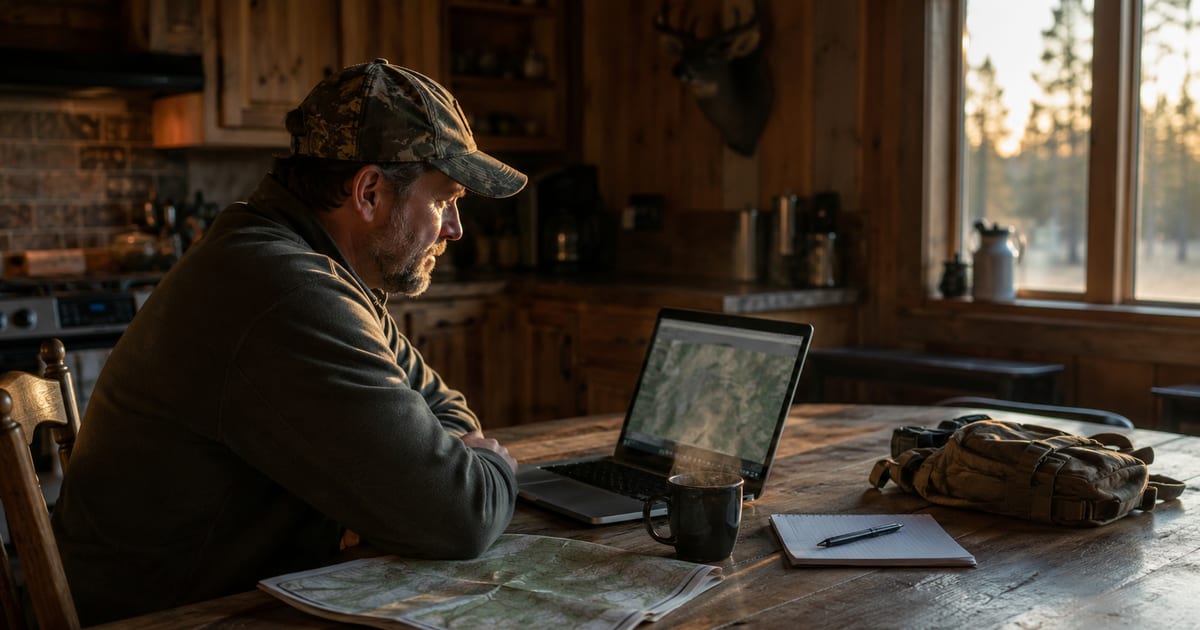
The time to locate your water sources is at the kitchen table, not at the trailhead. We layer three resources to build a complete water picture for any unit.
USGS 7.5-minute topo maps are the foundation. Blue lines indicate year-round streams. Dashed blue lines are intermittent — they flow seasonally and may be dry by September. Springs are marked with a small blue circle, sometimes labeled. Download the relevant quads through CalTopo or Caltopo’s mobile app so you have them offline.
OnX Hunt water layer adds a practical hunting overlay. Under the map layers menu, the water sources layer shows documented springs, seeps, stock tanks, and water developments (including those built by state wildlife agencies specifically for deer and elk). These show up on OnX as blue markers and are worth cross-referencing against your topo because some agency water developments won’t appear on older USGS maps.
Satellite imagery in late summer tells you whether those blue lines are actually holding water. Switch to satellite view in mid-August and zoom in on the creek drainages in your unit. Green riparian vegetation along a drainage in late summer almost always means flowing water. Brown, dry drainages need a backup plan. If you have access to recent scouting photos or unit-specific forums, compare notes — stock tanks can go dry or get vandalized between seasons.
Build your hunt plan around confirmed water, not assumed water. Mark primary sources, secondary sources, and note the distance between them. If you’re camping multiple nights, calculate whether you can refill without a significant side trip each day.
Filter Options Compared
Every backcountry hunter needs a primary filter and a backup. Here’s how the main options stack up for hunting-specific use cases.
Sawyer Squeeze is our default recommendation for weight-conscious hunters. At 3 ounces, it threads directly onto a SmartWater bottle, filters to 0.1 micron (removes bacteria and protozoa), and has a lifetime warranty. The critical limitation: the filter membrane will crack if it freezes while wet. On early-season rifle hunts above 9,000 feet, nighttime temps can drop below freezing. Keep your Sawyer inside your sleeping bag or pack it in your bibs chest pocket during the day.
Katadyn BeFree flows faster than the Sawyer — about a liter per minute versus the Squeeze’s roughly half-liter per minute. The soft flask design is packable and the flow rate matters when you’re filling a 3-liter reservoir at a sketchy trickle. Same freeze vulnerability as the Sawyer. Slightly heavier at about 2.6 ounces for just the filter (the included flask adds to that), but the speed advantage on fast fills is real.
SteriPen Adventurer uses UV light to neutralize pathogens without a physical membrane — no freezing risk, and it works on silty water that would clog a squeeze filter. The drawback is battery dependence. Carry lithium batteries (they perform better in cold), pack a spare set, and keep the unit in an inside pocket in freezing temps. UV treatment doesn’t remove chemical contaminants or improve taste, so pair it with a pre-filter for silty sources.
Chemical tablets (iodine or chlorine dioxide) are backup only. Chlorine dioxide tablets like Aquatabs or Potable Aqua PURE are effective against Cryptosporidium — iodine is not. Carry a small tube as a last-resort backup. Taste and the 30-minute wait time make them a poor primary option for all-day hunting.
Pro Tip
Carry a bandana or coffee filter to pre-filter silty water before running it through your Sawyer or Katadyn. It extends filter life dramatically on turbid glacial runoff and post-storm drainages.
Daily Water Needs at Elevation
The standard “8 glasses a day” guidance is not applicable in the backcountry. Here are the numbers we actually plan around:
- At rest, moderate altitude: 1 gallon (3.8 liters) per day minimum
- Active hunting day, 9,000+ feet: 1.5 to 2 gallons (5.7 to 7.6 liters)
- Spike camp mornings: Add 0.5 liters before leaving camp for the extra dry overnight breathing loss
For a three-day spike camp hunt, plan to filter at least 15 liters per person. That math should drive where you camp.
We target camps within a quarter mile of a confirmed water source. Not just for convenience — hauling 4 liters of water uphill to a dry ridgeline camp after a 6-mile approach is a real weight penalty and a morale problem at the end of a hard day. If the best elk basin you’ve identified sits on a dry ridge, plan your camp lower and commit to the extra elevation gain each morning.
Camp Placement and the 200-Foot Rule
Leave No Trace guidance calls for camping at least 200 feet (about 70 paces) from any water source. In elk country, that guidance has hunting logic behind it, not just conservation logic.
Elk and deer water at dawn and dusk. If your tent is pitched at the edge of a spring, every nearby animal will scent your camp as it approaches the water. You’re not just impacting the riparian ecosystem — you’re educating the elk that the water hole is compromised. We’ve seen bulls change their watering patterns within 24 hours of a camp being set too close to a spring.
200 feet also puts you above most bear activity concentrated around water sources. Bears patrol creek bottoms and spring areas regularly, and a game-scented camp at the water’s edge is a magnet for trouble. Set camp on a bench above the drainage, hang your food and meat properly, and leave the water corridor open for wildlife.
How Elk and Deer Use Water
Understanding wildlife water behavior is the tactical payoff for all the planning work above. In dry conditions — late August, September archery, any unit that’s been short on summer rain — water sources concentrate game predictably.
Elk are large-bodied animals with high water demands. A mature bull will drink 20 to 30 gallons per day in hot weather. During early September, elk typically water in the first and last hours of daylight and spend midday bedded in shade near water. A water hole in a shaded canyon bottom with good escape cover on multiple sides is a consistent elk location.
Mule deer are less dependent on free water than elk but still water daily in dry conditions. Does with fawns water more frequently and tend to visit smaller, quieter seeps that big bulls avoid. Bucks in velvet prioritize mineral-rich seeps over simple streams during late summer.
How to hunt water sources: Don’t set up directly at the water. Identify the approach trails leading to it — elk almost always use the same two or three paths repeatedly — and set your stand or blind along those approach routes, 80 to 150 yards from the water itself. This puts you on game that’s relaxed and moving predictably, rather than alert and scanning at the exposed water’s edge. Wind is critical here: the approach should keep your scent away from both the water source and the most likely approach trails.
In truly dry conditions during late-season hunts, check your OnX water layer for stock tanks and wildlife water developments. These small man-made sources often hold water long after natural streams have gone dry, and they funnel game from a wide area into a single predictable point. States like Arizona, Nevada, and New Mexico run extensive wildlife water programs — knowing which developments are active in your unit can reshape your whole hunt plan in a drought year.
Important
During drought years, state wildlife agencies often publish lists of which water developments in a unit are active and which have gone dry. Check with your regional wildlife office before your hunt — that list can reshape your entire scouting plan.
Pre-Hunt Water Checklist
Before leaving the trailhead on any backcountry hunt, run through these items:
- Primary water sources marked on offline map with confirmed late-season viability
- Secondary and emergency sources marked within 2 miles of planned camp
- Primary filter (Sawyer or Katadyn) clean and tested, stored unfrozen
- Backup option (SteriPen with fresh batteries, or tablets) in pack
- Daily water needs calculated and camp site chosen within quarter mile of primary source
- Water haul plan for spike camp mornings (extra 0.5L per person pre-loaded)
Water planning takes 30 minutes at the kitchen table and saves you from cutting a hunt short. The elk don’t care that you’re dehydrated. Plan the water, and you buy yourself the full days in the field that the rest of your preparation deserves. If you want a strategy check before season, the AI Advisor can review your unit, access route, and water plan and flag gaps you might have missed.
Frequently Asked Questions
Is it safe to drink directly from high-elevation mountain streams?
We don’t drink unfiltered from any backcountry source, regardless of how remote or pristine it looks. Giardia and Cryptosporidium are present in high-elevation water, carried by wildlife including the elk and deer you’re hunting. At 0.1 micron, a Sawyer Squeeze removes both. The filter weighs 3 ounces — there’s no good reason to skip it.
Can I use my Sawyer filter if overnight temps dropped below freezing?
If your Sawyer was wet when it froze, do not use it. A frozen wet membrane cracks in ways that aren’t visible, and a cracked membrane passes pathogens. If you suspect your filter froze wet, treat it as compromised and switch to your backup. To prevent freezing, sleep with your filter inside your sleeping bag or in a chest pocket of your base layer.
How do I find water in a unit I’ve never hunted before?
Layer your research: start with CalTopo topo maps (blue lines and spring symbols), add the OnX water layer for documented wildlife water sources, then check late-summer satellite imagery to confirm which drainages still hold moisture. Cross-reference with the state wildlife agency’s water development records for your unit. If possible, post a unit-specific question in a hunting forum — local hunters often know which springs historically go dry and which run all season.
Next Step
Check Draw Odds for Your State
Tag-level draw odds across 9 western states — filter by species, unit, weapon, and points. Free to use.
Get the Insider Edge
Join hunters getting exclusive draw odds data, gear deals, and weekly hunt planning tips.
Related Articles
Arizona OTC Archery Deer 2026: Unit Limits and Closures
Arizona's OTC archery deer season opens August 21, 2026 — and units close the moment harvest limits fill. Here's every unit's limit, plus the best bets by real archery success rates.
Colorado OTC Elk in 2026: What Changed for Nonresidents
Colorado eliminated unlimited nonresident OTC archery elk west of I-25 for 2026 — and Gunnison rifle tags went draw-only. Here's exactly what's still on the shelf and how to hunt this fall anyway.
Colorado Reissue Licenses: How to Grab Returned Elk Tags
Every Wednesday through fall, CPW sells back surrendered limited licenses — including elk tags nonresidents can't get any other way in 2026. Here's the Tuesday-Wednesday ritual that actually lands one.
No comments yet. Be the first to share your experience!