Backcountry Hunting Food: Calories, Weight, and Camp Cooking
Backcountry hunting food guide — calorie targets for hard days, freeze-dried vs DIY food, stove systems, water treatment, and meal planning for 5–7 day elk hunts.
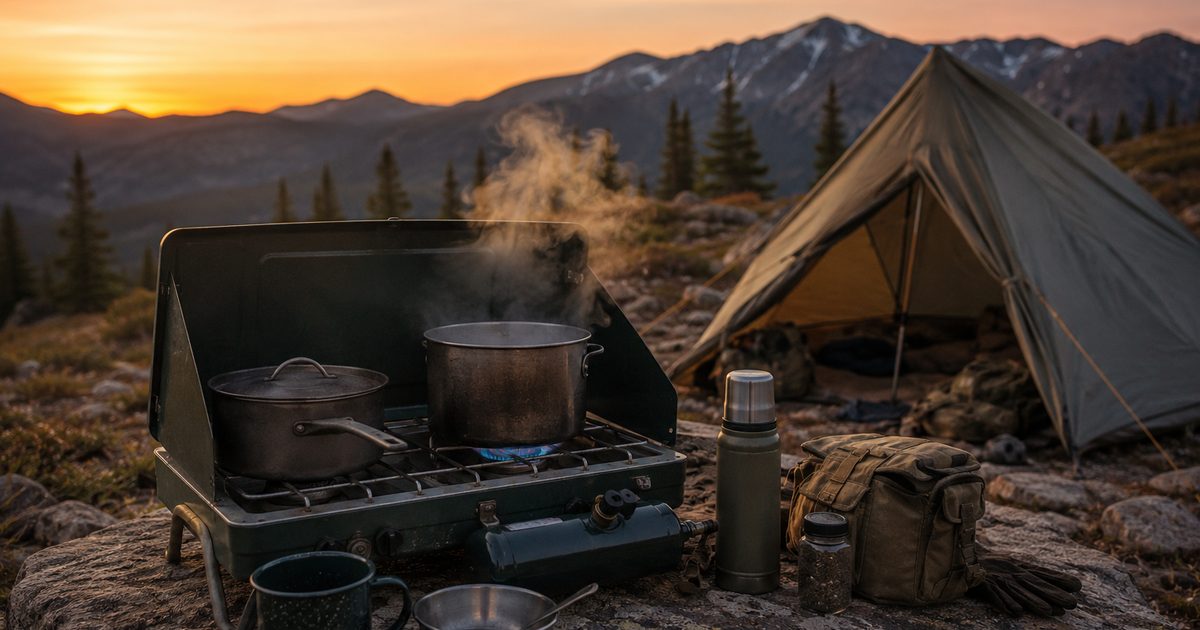
Food is where most first-time backcountry hunters cut corners and pay for it hard on day three. We’ve seen hunters bonk at 10,000 feet, pack out early, or spend entire evenings too depleted to glass — all because they underestimated how much fuel a hard mountain day actually demands. This guide covers everything we’ve learned about calories, weight, stove systems, and water treatment for multi-day backcountry elk hunts.
How Many Calories Do You Actually Need
The number most people quote — 2,000 calories — is built for a sedentary office day. In the backcountry, that math falls apart fast.
A reasonable baseline for a 5–7 day elk hunt with 1,500–3,000 feet of daily gain, a 40-pound pack, and temperatures below freezing at night is 3,500 to 4,500 calories per day. On your hardest days — a long push to a new drainage, a steep morning approach before first light — that number can push past 5,000.
The variables that drive calorie demand up:
- Elevation: Your body works harder to process oxygen above 8,000 feet, and acclimatization burns extra energy for the first two days.
- Pack weight: Every pound on your back multiplies the calorie cost of climbing. A 50-pound pack burns roughly 40% more calories per mile than a 25-pound pack on the same terrain.
- Cold: Keeping your core warm is metabolically expensive. Nights in the 20s add several hundred calories of passive burn before you even get out of your sleeping bag.
- Hunting exertion: Dragging a bull elk quarter a mile downhill to a game trail isn’t hiking — it’s a full workout.
We target 3,200 calories as our floor for any day that involves a morning hunt, midday glassing, and an evening hunt. If we’re doing a hard move to a new camp or packing out meat, we plan for 4,000+.
Calories per Ounce: The Only Math That Matters
In a backpack hunt, weight is finite. You can’t carry a week of 4,000-calorie days if your food averages 60 calories per ounce — that’s nearly 11 pounds of food per day. The target for weight-sensitive trips is 100 calories per ounce or better.
Here’s how common foods stack up:
- Olive oil: ~250 cal/oz (the densest portable energy available)
- Nut butter packets: ~170 cal/oz
- Salami/hard sausage: ~130–150 cal/oz
- Mixed nuts: ~165 cal/oz
- Freeze-dried meals: ~90–120 cal/oz (varies significantly by brand and meal)
- Hard cheese: ~115 cal/oz
- Tortillas: ~85 cal/oz
- Instant oatmeal packets: ~100 cal/oz
- Energy bars (Clif, Kind): ~100–120 cal/oz
- Jerky: ~70–80 cal/oz (lower than most people expect)
Adding a small bottle of olive oil to your pack and drizzling it on everything — freeze-dried meals, oatmeal, pasta — is one of the fastest ways to boost calorie density without adding bulk.
Pro Tip
Shoot for an overall food bag that averages 110–120 cal/oz. At that density, feeding yourself 3,500 calories per day costs about 29–32 oz — just under two pounds of food daily, or 12–14 pounds for a 7-day hunt before meat weight enters the picture.
Freeze-Dried Meals vs. DIY Food
Both approaches work. The question is how much prep time you want to put in before the hunt and how much you care about meal variety versus simplicity.
Freeze-dried packaged meals are the path of least resistance. You boil water, pour it in, wait 8–10 minutes, and eat. The major brands we use:
- Mountain House: The most widely available, with consistent texture and solid calorie counts. Their beef stew and chicken and rice are reliable crowd-pleasers. Servings are labeled for two people but most hunters eat the whole pouch.
- Backpacker’s Pantry: Slightly more variety and a few higher-cal options per pouch. Their pad thai is a morale boost mid-hunt.
- Heather’s Choice: Premium option with real ingredients and higher protein per serving. More expensive, but better for hunters who need to keep energy levels stable rather than spiked.
The downsides: cost (premium freeze-dried meals run $10–$15 per pouch), and the assumption that you always have enough stove fuel and time to boil water properly.
DIY food is cheaper, more calorie-dense per dollar, and more customizable. A standard day kit we’ve used on 6-day elk hunts:
- Breakfast: Instant oatmeal with a nut butter packet and a handful of nuts mixed in (~600 cal)
- Lunch: 2 tortillas with salami, hard cheese, and a squeeze of mustard, plus a bar (~700 cal)
- Snacks: Trail mix, a second bar, jerky throughout the day (~700–800 cal)
- Dinner: Instant mashed potatoes or ramen doctored with olive oil, a packet of tuna or salmon, and a bullion cube (~800–1,000 cal)
Total: 2,800–3,100 calories, and you can easily push past 3,500 by adding more nut butter and oil without changing your kit substantially.
The downside of DIY is that it requires more planning and packaging at home. Vacuum-seal or zip-lock individual day bags before the trip — it saves significant time at camp and helps you track consumption.
Stove Systems
Your stove choice affects not just cooking but your entire fuel logistics plan for the trip.
Canister stoves (JetBoil, MSR PocketRocket, Snow Peak) are the default choice for most backcountry hunters. They’re fast, reliable, and easy to use with gloves. The drawback: performance drops significantly in cold weather (below 20°F canister pressure falls off), and you can’t refuel mid-trip without a cached canister.
For a 7-day hunt, plan on roughly one 100g canister for boiling water for freeze-dried meals twice a day (closer to 230g if you’re also melting snow for drinking water). Bring more than you think you need — altitude cooking takes longer than sea-level testing at home.
Alcohol stoves are ultralight and cheap, but they struggle badly at altitude and in cold temperatures. We don’t recommend them as a primary stove above 9,000 feet.
Wood-burning stoves (like the Biolite) eliminate fuel weight entirely but depend on finding dry fuel at your campsite — which is not guaranteed in alpine terrain above treeline. They’re also slower and produce more smoke, which can be a concern in dry fire conditions.
Warning
Wind is the biggest enemy of canister stoves at altitude. A stove that boils water in 2 minutes at home can take 8–10 minutes in 30-mph gusts above 10,000 feet. Always carry a windscreen and plan your boil time into camp routine — don’t start cooking when you’re already starving and exhausted.
High-Altitude Boiling
Water boils at lower temperatures as elevation increases — at 10,000 feet, it boils around 194°F instead of 212°F. For freeze-dried meals that require “boiling water,” this matters: food rehydrates more slowly and some starchy items (pasta, rice) stay slightly firm. Add 2–3 extra minutes of soak time at elevation and you’ll get better results.
Water Treatment
Dehydration is a serious risk in the backcountry, especially at altitude where the sensation of thirst is blunted. Plan on filtering and drinking at least 3–4 liters per day on active hunting days.
Squeeze filters (Sawyer Squeeze, Sawyer Mini) are lightweight, fast, and don’t require any chemicals or UV exposure time. The Sawyer Squeeze handles a full 1-liter bag in about 60 seconds and filters down to 0.1 microns, which covers Giardia and bacteria. The weakness: they can freeze solid overnight in below-freezing camps, ruining the filter permanently. Sleep with your Sawyer in your sleeping bag if temperatures drop below freezing.
Chemical treatment (Aquatabs, Potable Aqua iodine) is a bulletproof backup. Tablets can’t freeze, never fail mechanically, and weigh almost nothing. The tradeoff is taste (iodine especially) and a 30-minute wait time. We carry a small bottle of tablets as backup even when using a filter.
UV purifiers (SteriPen) are fast and effective but battery-dependent. At altitude and in cold temps, battery performance degrades quickly. A SteriPen is a great primary option if you’re disciplined about battery management, but we wouldn’t rely on it as a solo solution for a week-long hunt.
Our standard setup: Sawyer Squeeze as the primary, Aquatabs as the backup, and a 2-liter soft flask for camp water storage.
Bear Canisters and Food Storage
Many wilderness areas in prime elk country — including large portions of the Frank Church in Idaho, the Eagle Cap in Oregon, and designated wilderness in Colorado and Wyoming — require hard-sided bear canisters for overnight food storage. Check the specific regulations for your unit before your trip; violating canister requirements in wilderness can result in a citation.
Even in areas where canisters aren’t mandated, hanging food (proper PCT hang or bear box) is required in most national forest and BLM wilderness units. A hard canister adds 2–3 pounds to your pack but simplifies camp routine considerably — no searching for a suitable tree at 11,500 feet in the dark.
Important
Keep tomorrow’s breakfast and a snack inside your sleeping bag at night in very cold camps — not for bear reasons, but because frozen chocolate bars and rock-hard jerky at 5 a.m. are a miserable way to start a hunt day. Many calorie-dense foods become difficult to chew when frozen solid.
Pack-Out Math: Food Weight vs. Meat Weight
Here’s the counterintuitive math of a successful elk hunt: your food bag gets lighter every day, but if you connect on a bull, your pack suddenly gains 120–200 pounds of boned-out meat that needs to move to the trailhead.
For a 6-day hunt, you’ll eat through roughly 10–12 pounds of food by the time you’re ready to head out. But a mature bull elk will yield 180–220 pounds of boneless meat, typically hauled in 4–6 loads depending on distance. If you’re hunting solo, that meat haul can take multiple days.
Plan your food carry with this in mind: don’t ration so aggressively that you’re running on empty when the real work starts. A successful pack-out is not the time to be calorie-depleted. Keep a small cache of high-density emergency food (a few bars, nut butter packets) that you don’t touch during the hunt — it’s your pack-out fuel reserve.
Meal Planning for a 5–7 Day Elk Hunt
A practical approach we use: plan day-by-day bags before the trip, with a daily calorie target of 3,500 and a hard cutoff at 2.2 pounds of food per day. Label each bag Day 1 through Day 7. Day 7 is intentionally lighter (half-day out to the trailhead) and Day 1 often includes fresh food eaten the first night before it spoils.
Vary your meals — eating the same freeze-dried pasta for seven dinners is a real morale issue by day four. Mix one or two premium freeze-dried meals with DIY dinners. A small bottle of hot sauce, a few packets of instant coffee, and a handful of hard candy take up almost no space and make a disproportionate difference at the end of a long, cold day.
For how to build the rest of your kit, see our hunting daypack guide.
Frequently Asked Questions
How much food should I pack for a 7-day elk hunt?
Plan for roughly 2–2.2 pounds of food per day, targeting 100+ calories per ounce. That puts your total food carry at 14–16 pounds for a 7-day hunt before meat weight. If you’re going heavier on freeze-dried meals (which average closer to 90 cal/oz), budget toward the higher end.
Is freeze-dried food worth the cost for backcountry hunting?
For most hunters, a hybrid approach makes the most sense. Use freeze-dried for dinners — where hot food matters most for morale and recovery — and DIY food for breakfast, lunch, and snacks. This balances cost with convenience and keeps calorie density high across the full day.
What stove system works best at high altitude for elk hunting?
A canister stove with an integrated windscreen is the most reliable option for high-altitude elk hunting. The JetBoil Flash and MSR PocketRocket 2 are proven performers. Bring more fuel than your at-home tests suggest — cold temperatures and altitude both reduce efficiency significantly. For a 7-day hunt with two cooked meals per day, carry at least two 100g canisters.
Do I need a bear canister for backcountry elk hunting?
It depends on your specific unit and wilderness designation. Many popular elk wilderness areas in the West require hard-sided canisters — always check the specific regulations for your hunt unit before you go. Even where not required, hanging food or using a canister is strongly recommended in active bear country.
Next Step
Check Draw Odds for Your State
Tag-level draw odds across 9 western states — filter by species, unit, weapon, and points. Free to use.
Get the Insider Edge
Join hunters getting exclusive draw odds data, gear deals, and weekly hunt planning tips.
Related Articles
Arizona OTC Archery Deer 2026: Unit Limits and Closures
Arizona's OTC archery deer season opens August 21, 2026 — and units close the moment harvest limits fill. Here's every unit's limit, plus the best bets by real archery success rates.
Colorado OTC Elk in 2026: What Changed for Nonresidents
Colorado eliminated unlimited nonresident OTC archery elk west of I-25 for 2026 — and Gunnison rifle tags went draw-only. Here's exactly what's still on the shelf and how to hunt this fall anyway.
Colorado Reissue Licenses: How to Grab Returned Elk Tags
Every Wednesday through fall, CPW sells back surrendered limited licenses — including elk tags nonresidents can't get any other way in 2026. Here's the Tuesday-Wednesday ritual that actually lands one.
No comments yet. Be the first to share your experience!